What “current medical knowledge” means when guidelines carry a date — and what a patient may, and may not, demand.
Thesis of this analysis
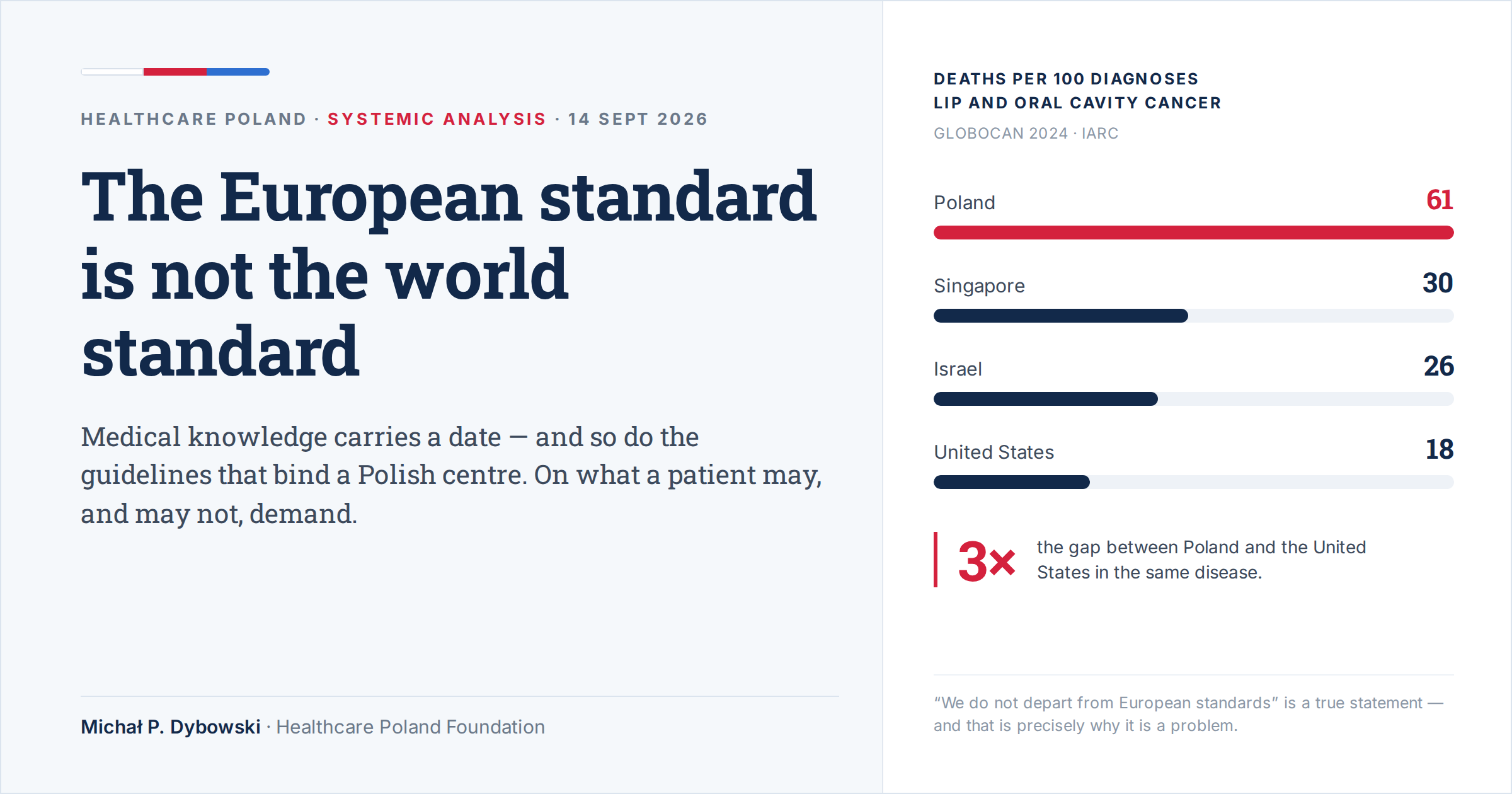
“We do not depart from European standards” is a true statement — and that is precisely why it is a problem. The European standard is not a benchmark to aspire to. It is the average of a continent from which three other systems have moved away by a factor of three.
Instead of an introduction: one conversation and three sentences
A conversation took place today with the head of a clinical department at a reference centre, in which three sentences were said. First: that a treatment plan cannot be established without the patient taking part in person. Second: that the proposed treatment regimen is an off-label regimen, which the centre will not administer. Third: that the conduct of this centre does not depart from European standards.
None of these sentences was said in bad faith. All three can, however, be verified — against the law, against marketing authorisation documents and against population data — and the result of that verification is different for each of them. The first has no basis in any norm of generally applicable law, although it does have a basis in the physician’s clinical discretion. The second is half true. The third is true in full — and that is precisely why it is a problem.
This analysis deals with the third sentence. Not in order to prove anyone wrong, but because it carries an assumption that nobody in the Polish debate on oncology says out loud: that the European standard is the benchmark to aspire to. Population data say that it is a benchmark from which the world has already moved away. If so, then the sentence “we do not depart from European standards” is not a defence. It is a description of the place where we stand together with Europe — and a question whether this is the place where we want to stand.
The illustration remains the case I know best, because it is mine: squamous cell carcinoma of the oral cavity, cT4 N2 M0, PD-L1 positive, an oncological diagnosis and treatment card, and a reference centre capable of delivering every element of the treatment. The case is laboratory-clean, because it contains no queue, no missing equipment and no ill will. The mechanism itself is visible.
Caveats at the outset
I make no accusation against anyone. A physician who makes participation in the therapeutic team conditional on examining the patient in person exercises a power granted to him by Article 42(1) of the Act on the Professions of Physician and Dentist. A physician who refuses a regimen lying outside the document binding upon him acts within the limits of Article 4 of that Act and Article 6 of the Code of Medical Ethics.
I do not claim that Europe does not treat cancer, nor that Polish oncology is making no progress — chapter 7 cites data also where they weaken the thesis. I claim one thing: that the benchmark has been set too low, and that this choice has a date, an author and an addressee.
1. Three sentences and their status
| Sentence from the conversation | What the law or the document says | Status |
|---|---|---|
| “A treatment plan cannot be established without the patient taking part in person” | Article 16 of the Act on the National Oncology Network permits a treatment plan to be established by a multidisciplinary therapeutic team through ICT systems, in real time; § 4a of the regulation on hospital benefits sets out the composition of the team and the deadline, and says nothing about the patient’s presence; the template of the DiLO card contains no field for the patient’s presence. Article 42(1) of the Act on the Professions of Physician and Dentist permits a medical opinion to be issued after examination in person or through communication systems. | It is not a legal norm. It is an admissible clinical decision of an individual physician — and nothing more. It cannot justify the absence of any action whatsoever until an in-person visit takes place. |
| “This is an off-label regimen” | Pre-operative pembrolizumab as monotherapy at CPS ≥ 1 — consistent with the SmPC since the European Commission decision of 29 October 2025 and named expressly in NCCN v2.2026 (OR-3) for oral cavity cancer. Adding cisplatin and paclitaxel to the pre-operative phase — outside the SmPC; no phase III trials. | Half true. The “off-label” label correctly describes pre-operative chemotherapy, and incorrectly describes pre-operative immunotherapy. |
| “We do not depart from European standards” | The EHNS-ESMO-ESTRO guideline for head and neck cancer dates from 2020; the Polish adaptation of the NCCN guidelines — from 12 June 2025; the PTOK chapter — from 7 August 2014. None of these documents contains the regimen authorised in the European Union on 29 October 2025. | True in full. The centre stands on the ground of the documents binding upon it. The problem lies with the date of those documents, and with what they are a benchmark for. |
The first sentence has a simple practical consequence and has already been described in the analysis of 8 September: the law does not prohibit establishing a plan remotely, but the physician may consider that he needs an examination — and he then has at his disposal either a remote real-time examination or an in-person one. The sentence “the patient must be present” is a power of the physician, not an obligation of the patient, and it does not stop the running of the 14-day deadline for the plan and the commencement of treatment, counted from entry on the waiting list under the DiLO card.
The second sentence was broken down into its components on 9 September and nothing in it has changed since — except that the positive PD-L1 result of 13 September closed the last gap: the CPS ≥ 1 condition, on which the European marketing authorisation and the NCCN algorithm make pre-operative immunotherapy dependent, is met.
The third sentence remains. The rest of this text is about it.
2. What the data say — four countries, one disease
I will start with the measure that is simplest and most resistant to methodological dispute: the ratio of the number of deaths to the number of new cases in the same year, in the same cancer site, according to the same source. This is not a survival measure — it is a measure of what proportion of the disease diagnosed in a given country ends there in death. It depends on the stage at diagnosis, on the quality of treatment and on the completeness of registries; it does not depend on exchange rates or on rhetoric.
In Poland, for every hundred diagnoses of oral cavity cancer there are sixty-one deaths. In Israel — twenty-six. In the United States — eighteen. The difference is not a difference of a dozen or so per cent; it is a threefold difference.
The same measure for all cancers taken together says less, because it depends on the structure of incidence, but the direction is the same. The age-standardised mortality rate for malignant neoplasms (world, per 100,000) is, according to GLOBOCAN 2024: Poland 123.9, United States 80.0, Israel 77.5, Singapore 70.6 — against incidence rates of 255.8, 358.5, 233.7 and 202.9 respectively. The United States diagnoses cancer 40 per cent more often than Poland, and mortality from it there is 35 per cent lower.
European data show where Europe sits in this picture. The EUROCARE-5 study (some 250,000 patients from 86 registries, diagnoses from 1999–2007) reported five-year relative survival for head and neck cancers other than laryngeal cancer at 28 per cent in Eastern European countries against 46 per cent in Ireland, the United Kingdom and Northern Europe, with the caveat that adjusting for tumour site reduces the difference. More than half of the patients in Europe were diagnosed at a regional or distant stage. By comparison, the American SEER registry reports, for tongue cancer diagnosed in 2015–2021, five-year relative survival of 88 per cent at the localised stage and 70 per cent at the regional stage.
Three honest caveats
First — stage. A significant part of the difference between Poland and the United States or Israel arises before the first visit to an oncologist: in the dentist’s surgery, in the ENT clinic, in primary care. My own case is an illustration of this — 85 days passed from the first course of antibiotics to the histopathology result. The deaths-to-cases ratio measures the whole system, not oncology alone.
Second — risk factors. The structure of oral cavity cancers in Poland is more tobacco- and alcohol-driven, while in the United States HPV-related disease, with a better prognosis, accounts for a larger share. This genuinely explains part of the difference. It does not explain a factor of three.
Third — registries. For many countries GLOBOCAN estimates rather than counts. The direction and the order of magnitude are nevertheless consistent with the data of the Polish National Cancer Registry, according to which in 2021 there were 4,530 new cases of cancer of the oral cavity and pharynx in Poland and 3,089 deaths.
It does not follow from these data that Europe “does not treat”. Something more precise follows: that the “European standard” is an average of a continent whose eastern part achieves, in this group of cancers, results half as good as its northern part, and that the continent as a whole achieves results worse than three systems worth comparing ourselves with. The sentence “we do not depart from the European standard” is therefore true and at the same time says nothing about whether we treat well.
3. Knowledge carries a date — the calendar of a single regimen
The dispute over whether pre-operative immunotherapy is a “standard” can be settled without opinions, by dates alone. Below is the calendar of a single regimen: perioperative pembrolizumab in resectable, locally advanced squamous cell carcinoma of the head and neck with PD-L1 expression (the KEYNOTE-689 trial).
| Date | Event | Who |
|---|---|---|
| 7 August 2014 | The chapter “Epithelial tumours of the head and neck” in the PTOK recommendations — the document referred to by § 6a of the benefit-basket regulation for outpatient specialist care | PTOK |
| 2020 | The EHNS-ESMO-ESTRO guideline for squamous cell carcinoma of the head and neck | ESMO |
| 12 June 2025 | The Polish adaptation of the NCCN guidelines (Poland Edition v2.2025) — the document on which the National Monitoring Centre relies | NIO-PIB |
| July 2025 | Publication of the KEYNOTE-689 results in the New England Journal of Medicine (2025;393:37–50) | investigators |
| 29 October 2025 | European Commission decision — extension of the Keytruda indications to perioperative treatment | EC |
| 8 December 2025 | NCCN Head and Neck Cancers v1.2026 — the regimen on page OR-3 for oral cavity cancer | NCCN |
| 12 May 2026 | NCCN v2.2026 — the same regimen, the document in force today | NCCN |
| 14 September 2026 | The conversation in which the regimen was called off-label | — |
Status as at 14 September 2026. An open bar means that none of the documents binding upon the Polish centre has been amended since the marketing authorisation decision.
Observation one. Less than half a year passed from publication in the NEJM to the change in the source NCCN guidelines; from the marketing authorisation decision — 40 days. From that same decision until today, 320 days have passed and none of the three documents used by the Polish centre has been amended in that time. This is not the negligence of any individual. Article 22(2)(1) of the Act on the National Oncology Network obliges the National Monitoring Centre to “ensure the development and updating” of guidelines — with no deadline, no cycle, no sanction and no link to a marketing authorisation event. The same legislator was able to impose on a hospital the obligation to establish a treatment plan within 14 days.
Observation two. The document with the oldest date — the PTOK chapter of 2014 — is at the same time the document referred to by the benefit-basket regulation. That chapter contains no immunotherapy in any setting, because the first checkpoint inhibitor was authorised in this indication two years after it was issued. A physician who says “we do not depart from the standard” is right about the standard that binds him. He is right, however, about a standard from a year in which none of the methods now in dispute yet existed.
4. “Current medical knowledge” — what it means in law
Polish law does not use the notion of a “European standard”. Nor does it use the notion of “guidelines” as the limit of a physician’s obligation. It uses the notion of current medical knowledge — and it uses it consistently across three acts.
Three provisions
Article 4 of the Act on the Professions of Physician and Dentist: a physician is obliged to practise “in accordance with the indications of current medical knowledge, with the methods and means of prevention, diagnosis and treatment of diseases available to him, in accordance with the principles of professional ethics and with due diligence”.
Article 6(1) of the Act on Patients’ Rights and the Patients’ Rights Ombudsman: a patient has the right to health services “corresponding to the requirements of current medical knowledge”.
Article 68(1) of the Constitution of the Republic of Poland: everyone has the right to the protection of health; paragraph 2: public authorities shall ensure equal access to health care services financed from public funds to citizens, irrespective of their material situation, and the conditions and scope of provision of such services shall be determined by statute.
Guidelines are evidence of knowledge, not its limit. Article 4 does not refer to the guidelines of a scientific society, nor to the date of their latest adaptation. It refers to knowledge — and knowledge exists from the moment it is published and verified, not from the moment it is transcribed into a national document. A randomised phase III trial published in the NEJM, a marketing authorisation decision of the European Commission based on the EMA assessment, and the algorithm of the most widely used oncological guidelines in the world are current medical knowledge within the meaning of Article 4 — irrespective of whether the Polish adaptation has managed to record them. Whoever claims otherwise claims that medical knowledge comes into being in Poland on the day a document is issued by the National Monitoring Centre. That proposition cannot be defended, either legally or logically.
But knowledge is not a claim. Article 4 also says “with the methods available to him”, Article 6 of the Code of Medical Ethics grants the physician “freedom of choice as to the methods of management which he considers most effective”, and Polish law construes patient autonomy as a negative right: the right to refuse consent is almost absolute, the right to demand a particular therapy does not exist. A patient cannot order a physician to use a method the physician does not accept — and should not attempt to, because Article 38 of the Act on the Professions of Physician and Dentist allows a physician to withdraw from treatment. Article 68(2) of the Constitution guarantees equal access to services financed from public funds, not access to every service; the scope is determined by statute, and the statute — through the benefit basket and the reimbursement list — determines it narrowly.
What the patient is therefore entitled to — and what is fully enforceable
The right to information about all possible methods. Article 9(2) of the Act on Patients’ Rights and Article 31(1) of the Act on the Professions of Physician and Dentist impose the obligation to inform the patient of the possible diagnostic and therapeutic methods and of the foreseeable consequences of applying or omitting them. “Possible” — not “used in this centre” and not “financed”. A physician may refuse to apply a regimen; he may not refuse the information that the regimen exists, where it is available and what the patient loses by forgoing it. The absence of that information is an infringement of patients’ rights. A refusal of therapy is not.
The right to demand a consultation panel or a second opinion. Article 6(3)–(5) of the Act on Patients’ Rights and Article 37 of the Act on the Professions of Physician and Dentist. A physician may refuse if he considers the request unfounded — but both the request and the refusal are recorded in the medical documentation. The outcome is favourable in either variant: either a consultation panel, or a documented refusal with reasons.
The right to a date and to its justification. Article 20(2)(2) of the Act on Health Care Services: a patient has the right to information about the date and, upon request, to a justification of the reasons for its selection. For waiting lists kept on the basis of the DiLO card, the treatment plan and the commencement of treatment are to occur within 14 days of entry (§ 4a of the regulation on hospital benefits).
And one right that does not exist: the right to have applied a regimen which the physician does not accept. Whoever builds a dispute on that non-existent right loses it before it begins — and loses at the same time the rights he does have.
5. The “15–20 per cent” statement — what was said and what has been proven
In the conversation with the Polish centre, reference was made to a statement by an Israeli oncologist about the effectiveness of the proposed regimen. Since that figure is already circulating in public documents, it must be put in order — precisely, without smoothing it in either direction.
What was said. Recording of the consultation of 7 September (28 min 32 s, minute 06:38): the prognosis at stage IVA “was 60, 60–70 per cent”; with a positive PD-L1 marker “you give two courses of Keytruda before, then you operate, then you irradiate with chemotherapy, and the chances of cure rise by 15 to 20 per cent”. And: “in your case, because you are young and the disease is rather aggressive, I would add chemotherapy to the immunotherapy”.
What has been proven. The KEYNOTE-689 trial (Uppaluri R. et al., N Engl J Med 2025;393:37–50), of which the physician is a co-author: for CPS ≥ 1, event-free survival at three years of 58.2 against 44.9 per cent — a difference of 13.3 percentage points, HR 0.70 (95% CI 0.55–0.89); overall survival not formally demonstrated at this stage of the analysis. The regimen studied: pembrolizumab as monotherapy before surgery, without chemotherapy.
How to reconcile the two. “15–20 per cent” is a clinician’s rounding in conversation with a patient, falling within the margin of error and consistent in direction with the trial data. It is not a figure that can be cited in a letter to a centre or in public material — the correct figure reads “more than 13 percentage points in event-free survival at three years of follow-up, in the group of patients with positive PD-L1”. Adding chemotherapy to the pre-operative phase, by contrast, is — exactly as the physician called it — his clinical judgement for this particular patient, based on the centre’s experience, not on a phase III trial. Calling it an “in-house protocol of the centre” is correct. Calling it “the protocol” is misleading, because it suggests a document that does not exist.
This chapter is in the text in order to show what honest use of data looks like: one cites the trial, not the conversation; the difference in percentage points, not “the percentage of cures”; and one distinguishes what has been proven from what an experienced clinician considers right. The Polish centre has the right to refuse the second. It has no grounds to call the first off-label.
6. Where the public payer fits into all this
The sentence “the National Health Fund does not reimburse this” was broken down into its components in the analysis of 13 September. Here it is enough to recall its conclusion, because the conversation of 14 September confirmed it.
Pembrolizumab is reimbursed in Poland under drug programme B.52 for the same diagnosis (C03) — but solely in recurrent or metastatic disease. In perioperative treatment, authorised in the European Union on 29 October 2025, it is not reimbursed, because no application by the marketing authorisation holder, no commission from the Minister of Health and no recommendation of the Agency for Health Technology Assessment and Tariff System could be found. Reimbursement proceedings are initiated solely by the company (Article 2(27) and Article 24 of the Reimbursement Act) or — optionally and without any deadline — by the minister acting ex officio (Article 40). The patient, the physician, the hospital and the national consultant have no standing in those proceedings.
This is not a “reimbursement discrepancy” that can be reported as an error, because there is no authority that would correct such an error. It is the absence of a decision which nobody is obliged to issue. That is why the postulate of 13 September remains valid and is the only one that can be addressed: within 90 days of the EU marketing authorisation of an oncology medicine, the Minister of Health either initiates proceedings ex officio or publishes information on the reasons for refraining from doing so. Three sentences in the Reimbursement Act. Budgetary cost: zero, until a substantive decision is taken.
7. An honest balance sheet
An argument built on omission is refuted by a single sentence, and brings down everything else with it. That is why three things must be said in favour of the system this text criticises.
Polish oncology is improving — and faster than the EU average. According to the EFPIA Patients W.A.I.T. Indicator, 2025 edition, the availability of new oncology medicines in Poland stands at 61 per cent against an EU-27 average of 51 per cent, and the time to reimbursement has fallen from 909 days in the 2022 edition to 679 days. The country cancer profile for Poland prepared by the OECD and the European Commission in 2025 notes that cancer mortality is falling at a pace comparable to the EU average and faster than in countries at a similar level of development — with incidence below the average. Whoever does not acknowledge this forfeits the right to be heard.
What is most expensive, the system finances in full. Microsurgical reconstruction of the mandible, intensive care, chemoradiotherapy, pathology, post-resection prosthetics, rehabilitation — without a cap, on the basis of the DiLO card, within hard deadlines. What is missing is one line in one annex.
The physician with whom the dispute is being conducted is acting correctly. He stands on the ground of the document that binds him; he exercises the powers he has; he proposed a date and a route to marketing authorisation. He is not an opponent. He is the addressee of a question he cannot himself answer, because the answer lies in the Act on the National Oncology Network and in the Reimbursement Act, and not in his clinic.
And one caveat in the other direction, so that the proportion is preserved: the same W.A.I.T. Indicator reports that full, unrestricted availability applies to 6 per cent of new medicines in Poland against 28 per cent in the European Union. “The medicine is reimbursed” and “this patient will receive it” are two different sentences in Poland. The distance between them is greater than anywhere else in the Union, and the case described in this text is an exact measure of that distance.
8. What follows — five theses
Thesis one — on the benchmark. The “European standard” is not a standard to aspire to; it is an average in which Eastern Europe achieves, in head and neck cancers, results half as good as Northern Europe, and Europe as a whole — worse than the United States, Israel and Singapore. The proper benchmark for Article 4 of the Act on the Professions of Physician and Dentist is current medical knowledge, and that has neither a nationality nor a continent. Guidelines are its evidence, not its limit.
Thesis two — on the date. The knowledge that binds a Polish physician carries, in this group of diagnoses, the dates 2014, 2020 and June 2025. The knowledge to which the statute refers carries the date of the latest publication. Between those dates lies every treatment refused today by reference to the standard — and nobody is obliged to narrow that gap. This is a gap to be closed with a single sentence in Article 22 of the Act on the National Oncology Network: an obligation to review the guidelines within 90 days of a marketing authorisation decision, with publication of the outcome — including a reasoned decision not to amend them.
Thesis three — on the distinction. A physician’s refusal to apply a regimen and a refusal of information about that regimen are two different acts. The first is a power of the physician. The second is an infringement of Article 9(2) of the Act on Patients’ Rights. A patient who enforces the first loses; a patient who enforces the second obtains a document — and a document is where every systemic repair begins.
Thesis four — on ad hoc access. Protocols from outside Europe do not have to be “introduced”; it is enough that a physician may apply them on his own responsibility where they are consistent with the marketing authorisation and with knowledge, and the patient has given consent and has financing. Today the obstacle is not the law — it is the absence of a settlement product for administering a medicine outside the list in a public centre, and the absence of uniform practice among hospital managements. This is a matter for an ordinance of the President of the National Health Fund, not for a statute.
Thesis five — on responsibility. There is no culprit in this matter. The physician was under no obligation to know a guideline that nobody had updated. The monitoring centre had no deadline that the statute never set. The company filed no application that nobody obliged it to file. A sum of correct behaviours produced a result that nobody designed. Where the rule ends, the human being begins — and that is why this text is not an indictment, but a description of the place where a rule is missing, and an indication of who can write it.
What this text does not claim
- It does not claim that anyone was refused treatment — one regimen was refused, and a date and a route to marketing authorisation were proposed.
- It does not claim that the physician breached the law.
- It does not claim that pre-operative chemotherapy is a standard — it is in no guideline.
- It contains neither a clinical recommendation nor legal advice.
- It does not claim that the threefold difference in the deaths-to-cases ratio is wholly to the credit or the fault of oncology — that ratio measures the whole system, from the dentist’s surgery to the reference centre.
Unverified items — excluded from the argument
The date of NCCN v2.2026 — from the footer of the document held by the author (05/12/2026); the NCCN website was not re-verified on the day this analysis was prepared. A possible update of the ESMO guideline after KEYNOTE-689 — not found; the guideline in force, EHNS-ESMO-ESTRO, dates from 2020. The date of any update of the PTOK chapter after 2014 — no more recent document for head and neck cancers was found on ptok.pl. A commission from the Minister of Health or a recommendation of AOTMiT for the perioperative indication — not found; the absence of a trace in public sources is not proof of non-existence. Supreme Court judgments on the right to choose a method of treatment — the holdings are known solely from secondary sources and have been deliberately omitted.
Legal acts. Constitution of the Republic of Poland, Article 68(1)–(2) · Act on the Professions of Physician and Dentist (consolidated text, Journal of Laws 2026, item 37), Articles 4, 31, 37, 38, 42 · Act on Patients’ Rights and the Patients’ Rights Ombudsman (consolidated text, Journal of Laws 2024, item 581, as amended), Articles 6, 9 · Act on the National Oncology Network (consolidated text, Journal of Laws 2024, item 1208, amended by Journal of Laws 2026, item 1007), Articles 16, 22, 24, 26 · Act on Health Care Services Financed from Public Funds (consolidated text, Journal of Laws 2025, item 1461), Articles 20, 47d, 136 · Reimbursement Act (consolidated text, Journal of Laws 2026, item 253), Article 2(27), Articles 24, 40 · Regulation of the Minister of Health on guaranteed benefits in the field of hospital treatment (consolidated text, Journal of Laws 2023, item 870), § 4a · Code of Medical Ethics (in force since 1 January 2025), Article 6.
Data. IARC, GLOBOCAN 2024 — country fact sheets for Poland, Israel, the United States and Singapore (gco.iarc.who.int, published July 2026) · Gatta G. et al., Prognoses and improvement for head and neck cancers diagnosed in Europe in early 2000s: the EUROCARE-5 population-based study, Eur J Cancer 2015;51:2130–2143 · Didkowska J. et al., Cancer incidence and mortality in Poland, Polish National Cancer Registry · American Cancer Society, Survival rates for oral cavity and oropharyngeal cancer (SEER 2015–2021) · Uppaluri R. et al., Neoadjuvant and Adjuvant Pembrolizumab in Locally Advanced Head and Neck Cancer, N Engl J Med 2025;393:37–50 · European Commission decision of 29 October 2025 and the Keytruda SmPC (EMA) · NCCN Head and Neck Cancers v1.2026 (8 December 2025) and v2.2026; NCCN Guidelines Poland Edition v2.2025 (NIO-PIB, 12 June 2025) · PTOK, Epithelial tumours of the head and neck, 7 August 2014 · EHNS-ESMO-ESTRO Clinical Practice Guideline: SCC of the Head and Neck, 2020 · EFPIA Patients W.A.I.T. Indicator 2025 · OECD/EC, EU Country Cancer Profile: Poland 2025 · Recording of the consultation of 7 September 2026 (transcript in the author’s files).
Related analyses. The line runs inside the medicine (HCPL, 13 September 2026) · legal analyses of 8 and 9 September 2026 (in the author’s files).
Michał P. Dybowski — President of the Management Board of the Healthcare Poland Foundation, CSO and Director of the Department of Green Hospitals and Security at the Polish Hospital Federation, Leader of the Regulatory Sandboxes and Innovation Support Section of GRAI at the Ministry of Digital Affairs, President of the Global Healthcare Systems Hub.
An analytical paper of the Healthcare Poland Foundation. Legal status and data as at 14 September 2026. This is not legal or medical advice.