Longevity 360 · Analysis · Poland
In 2025, people insured in Poland spent 290.5 million days on medical sick leave, and direct sickness payments totalled PLN 34.88 billion. This analysis asks what a moderate, realistic improvement is worth — cutting the number of sickness-absence days by 4% — to three parties: employers (X), the state as measured by gross domestic product (Y), and the Social Insurance Fund managed by ZUS (Z).
1. Baseline: the scale of the issue
ZUS data for 2025 show 27.5 million medical certificates and 290.5 million days of absence. The average certificate lasted 11 days, and roughly one in two insured persons received at least one. Fig. 1 shows who paid. ZUS paid PLN 20.71 bn (about 59%) in sickness benefits. Employers (and the Guaranteed Employee Benefits Fund, FGŚP) paid PLN 14.17 bn (about 41%) as statutory sick pay. As a rule, employers cover the first 33 days of illness in a calendar year, or 14 days for employees aged over 50.

The causes of absence matter too. Musculoskeletal disorders account for the most days (42.4 million). Mental and behavioural disorders have risen to second place (34.1 million days, up from 30.3 million, or about 12.5% year on year). In both groups, workplace prevention (ergonomics, physical activity, sleep and recovery, mental resilience) has a documented potential to make a difference.

2. Methodology
2.1. Scenario definition
The scenario assumes a relative 4% cut in the number of sickness-absence days (ΔD = 4% × 290.5 m = 11.62 m days). The mix of causes, financing periods and wages is held constant. This is not a 4-percentage-point fall in the absence rate; that would be unrealistic, because it would exceed the total amount of absence in the economy. The analysis is static (one year, with no multiplier or dynamic effects) and covers Poland only.
2.2. Input parameters
| Parameter | Value | Source |
|---|---|---|
| Days of sickness absence (2025) | 290.5 m | ZUS [1][2] |
| Sickness benefits paid by ZUS (2025) | PLN 20.71 bn | ZUS [3][4] |
| Statutory sick pay: employers/FGŚP (2025) | PLN 14.17 bn | ZUS, Ministry of Family, Labour and Social Policy, via [3] |
| GDP at current prices (2025) | PLN 3,912.7 bn | GUS [5] |
| Employed persons (LFS, 2025) | approx. 17.2 m | GUS [6] |
| Average gross monthly wage (2025) | PLN 8,903.56 | GUS [7] |
| Benefit rate (sick pay / sickness benefit) | 80% of the assessment base | Sickness Benefits Act; Labour Code art. 92 |
| Employee social contributions (deducted from the base) | 13.71% | Social Insurance System Act |
| Employer contributions (pension 9.76 + disability 6.5 + accident 1.67 + Labour Fund 2.45 + FGŚP 0.10) | 20.48% | statutory rates |
| Contributions paid into FUS (pension 19.52 + disability 8.0 + sickness 2.45 + accident 1.67) | 31.64% | Social Insurance System Act |
| Elasticity of output with respect to working time | 0.8 (range 0.5–1.0) | Koopmanschap et al. [8][9] |
| Calendar-to-working-day conversion | 250/365 | assumption |
2.3. Formulas
Gross wage equivalent covered by absence:
  W = (ZUS + Employers) / 0.80 / (1 − 0.1371) = 34.88 / 0.6903 ≈ PLN 50.5 bn
Full labour cost (incl. employer on-costs):
  K = W × 1.2048 ≈ PLN 60.9 bn  (≈ 1.56% of GDP)

X (employers):
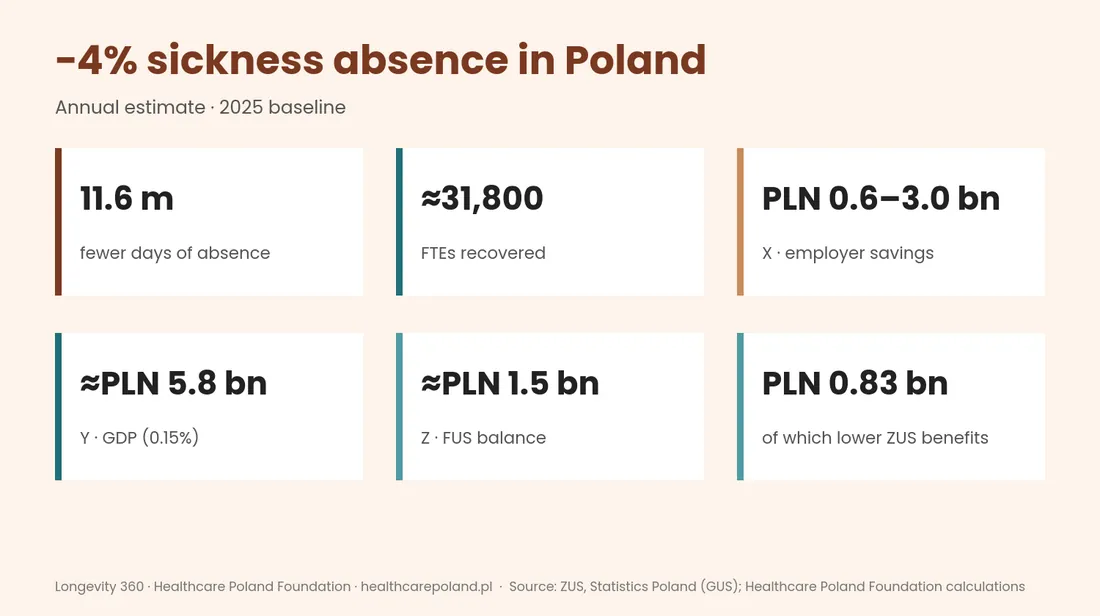
  X_direct = 4% × PLN 14.17 bn                     ≈ PLN 0.57 bn
  X_time   = 4% × K                                ≈ PLN 2.43 bn
  X        = X_direct + X_time                     ≈ PLN 3.00 bn

Y (GDP):
  ΔFTE     = ΔD × (250/365) / 250                  ≈ 31,800
  Y        = ΔFTE × (GDP / employed) × ε,  ε = 0.8 ≈ PLN 5.79 bn
             (ε = 0.5 → PLN 3.62 bn;  ε = 1.0 → PLN 7.24 bn)

Z (ZUS / FUS):
  Z_benefits      = 4% × PLN 20.71 bn              ≈ PLN 0.83 bn
  Z_contributions = 4% × W × 31.64%                ≈ PLN 0.64 bn
  Z_balance       = Z_benefits + Z_contributions   ≈ PLN 1.47 bn
2.4. Rationale for the approach
- Valuation from payments, not “days × average wage”. The wage equivalent is derived from benefits actually paid, not from days multiplied by the average wage. This is the more conservative method, because it reflects lower assessment bases (including those of the self-employed), benefit caps and the mix of eligible people. For comparison, valuing each calendar day at the average wage would give a figure about 1.7 times higher.
- Two layers of X. Xdirect is cash the employer no longer pays out as sick pay: a certain value that shows up in the accounts. Xtime values the recovered working time at full labour cost. It stands for what companies spend covering for absent staff (overtime, temporary workers, reassigned tasks), or the output they lose. It also includes days paid by ZUS, because the employer loses capacity whoever pays the benefit.
- Elasticity of 0.8. Under the friction-cost method, a 10% loss of working time is assumed to reduce output by about 8%, because some work is caught up later or taken over by colleagues [8][9]. The 0.5–1.0 range shows how uncertain this parameter is.
- FUS contributions. No social insurance contributions are paid on sickness benefits, but they are paid on wages. Each recovered working day therefore raises FUS income. Part of that income (the pension contribution) creates future pension liabilities, so not all of the current improvement in the balance is a permanent saving for the system.
3. Results

| Dimension | Measure | Annual value |
|---|---|---|
| X: employers | Lower statutory sick pay | PLN 0.57 bn |
| Value of recovered working time (full labour cost) | PLN 2.43 bn | |
| Total | approx. PLN 3.0 bn | |
| Y: state (GDP) | Central estimate (ε = 0.8) | approx. PLN 5.8 bn (0.15% of GDP) |
| Range (ε = 0.5–1.0) | PLN 3.6–7.2 bn | |
| Z: ZUS (FUS) | Lower sickness-benefit spending | PLN 0.83 bn |
| Higher contribution income | PLN 0.64 bn | |
| Improvement in FUS balance | approx. PLN 1.47 bn |
X, Y and Z should not be added together. They describe the same recovered working time from three angles: the company (microeconomic), value added (macroeconomic) and social insurance finances (FUS). Part of Z is also a transfer rather than new value.
Sensitivity analysis
The model is linear, so each additional percentage point of absence reduction adds about PLN 1.45 bn to GDP, about PLN 0.37 bn to the FUS balance and about PLN 0.75 bn in value for employers. A 10% reduction would raise GDP by about PLN 14.5 bn and improve the FUS balance by about PLN 3.7 bn.

4. Limitations
- ZUS data cover everyone with sickness insurance (including the self-employed), as well as leave taken to care for a family member. The model applies the same reduction across this whole population.
- The PLN 14.17 bn employer sick-pay figure comes from ZUS and ministry data quoted in the specialist press [3]. It should be checked against the original ZUS publication before it is quoted in official documents.
- The model leaves out presenteeism, staff turnover, recruitment costs, multiplier effects, and personal income tax and health contribution revenue. The full effect is therefore most likely larger than estimated.
- Some absence (for example, related to pregnancy or road-traffic injuries) cannot be reached by workplace prevention. A 4% reduction nationwide therefore implies a larger reduction in the areas where intervention can work.
- The analysis does not show that any particular programme is effective. It sets out what the effect would be worth if it were achieved.
5. Implications for employers and public policy
Three conclusions follow. The first concerns proportion: even a small improvement in workers’ health is worth billions of złoty, shared between companies, the economy and the social insurance system. The second concerns responsibility: the causes of absence, with mental disorders rising fast, show that part of the problem lies in how work is organised and in workplace culture, where employers have real influence. The third concerns measurability: the effects of prevention should be checked against aggregated data, not declarations.
The Healthcare Poland Foundation’s Longevity 360 programme is built on these principles. It has eight pillars (sleep and recovery, nutrition, physical activity, mindfulness, mental resilience, productivity, preventive health, purpose and habits). It is funded at cost from the company social benefits fund (ZFŚS) and delivers a quarterly HR report structured for ESRS S1/VSME reporting, while participants’ health data stay fully protected.
Sources
- ZUS, Sickness absence in 2025, summarised by Prawo.pl; ZUS monthly series: zus.pl
- Dziennik Gazeta Prawna: ZUS data, 290 million days of sick leave
- Dziennik Gazeta Prawna: sick leave costs billions (ZUS and ministry data: PLN 34.88 / 20.71 / 14.17 bn)
- Polityka Zdrowotna: ZUS report for 2025, PLN 20.7 bn on sick leave
- GUS, Gross domestic product in 2025, preliminary estimate; nominal value of PLN 3,912.7 bn as reported by Bank.pl
- GUS: Socio-economic situation of the country, labour market (LFS)
- GUS: Announcement on the average wage in the national economy in 2025
- Koopmanschap M.A. et al., The friction cost method for measuring indirect costs of disease, Journal of Health Economics 1995;14(2):171–189, PubMed
- Pritchard C., Sculpher M., Productivity Costs: Principles and Practice in Economic Evaluation, Office of Health Economics, 2000, OHE