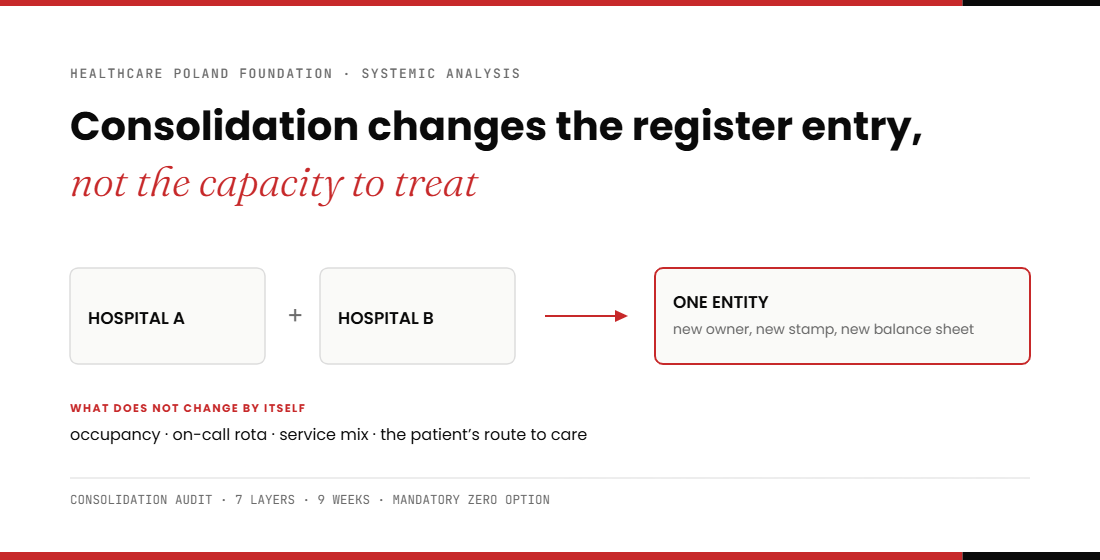
Merging hospitals without a prior diagnosis changes an entry in the register of healthcare providers, not a county’s capacity to treat its residents. The governing body changes, the letterhead changes, the balance sheet changes. Occupancy, on-call staffing and the structure of services do not — these are not parameters a council resolution can steer.
Consolidation is among the least reversible decisions a founding body makes. After a merger there are no longer two balance sheets, two contracts and two teams that can be separated again. An error made at the diagnostic stage stays in the system for years and is paid for by the patient — through a longer route to care — and by the councillor, through the question of why the promised savings never materialised.
Hence the rule underpinning the entire structure described below: the audit precedes the decision, it does not justify it. An audit commissioned after the resolution serves a documentary function. An audit commissioned before the resolution serves a determinative one — and only that kind has value for the body that bears responsibility for the outcome.
The facts: three events that changed the position of founding bodies within a year
| Date | Event | Consequence for the founding body |
|---|---|---|
| 17 Sept 2025 | Entry into force of the Act of 5 August 2025 (Journal of Laws 2025, item 1211) | Recovery programmes under new rules; an SPZOZ may be established by an association of local government units; mergers of SPZOZs with different founding bodies become possible |
| 14 May 2026 | Supreme Court resolution III CZP 41/25 | An SPZOZ has no restructuring capacity — the judicial recovery path is closed; what remains is the recovery programme, support from the founding body, and conversion into a company |
| 1 July – 30 Oct 2026 | Medical Fund consolidation call — PLN 1.149 billion | Up to PLN 70 million for inter-entity consolidation, up to PLN 20 million for intra-entity, up to 100% of costs, no own contribution; condition — a merger decision by 31 March 2027 |
The financial backdrop is unambiguous. Liabilities of public hospitals at the end of 2025 stood at PLN 34 billion across 562 entities, including PLN 4.9 billion in past-due liabilities; in the first quarter of 2026 SPZOZs alone reported PLN 30.2 billion in liabilities and PLN 5 billion past due (Ministry of Health data via Rynek Zdrowia, 7 July 2026).
In practice the decision window is short and closed at both ends. Applications are due by 30 October 2026, and the merger decision must be taken by 31 March 2027. A body that begins its diagnosis only after the call results are announced will be justifying a decision already made.
The advisory market exists. One function is missing from it
The restructuring advisory market for public hospitals is mature and worth tens of millions of zloty a year; individual engagements reach several hundred thousand. Two distinct categories of provider operate in it, and the difference matters to the founding body.
The first comprises restructuring advisers and law firms conducting court proceedings. Their competence is legal and creditor-facing. After resolution III CZP 41/25 their principal instrument — judicial restructuring — is no longer available to an SPZOZ.
The second comprises specialist medical advisory firms offering audits, development strategies, recovery programmes, operational and debt restructuring, benchmarking and feasibility studies. That competence is real and the hospital community works with it.
What the market lacks is a third function: an audit commissioned by the founding body and performed by an organisation that does not sell itself the implementation. An adviser whose next contract is the delivery of its own recommendations operates in a structural conflict — not through bad faith, but through the construction of the engagement. For such an adviser the recommendation “merge” is worth many times more than “do not merge, clean up the service profile and revisit this in a year”.
The Healthcare Poland Foundation works exclusively with healthcare providers and their founding bodies. It does not act as an investor, does not broker transactions and does not serve capital looking for medical assets. That narrowing is the price the Foundation pays for the one thing that makes an audit credible before a county council: no interest of its own in the substance of the decision.
Scope: seven layers, one answer
The audit examines seven layers and ends with an answer to a single question: does the merger increase capacity to treat the population the founding body is responsible for, and at what cost.
| Layer | What is examined | Determinative question |
|---|---|---|
| Clinical and service network | Ward profiles, duplicated scopes, patient migration outside the county, travel time after the merger | Which profile actually loses the patient, and which merely loses the capitation payment |
| Operational | Occupancy, operating theatre, diagnostics, on-call rotas, flows between sites | Does the merger remove the bottleneck, or move it 30 km away |
| Financial | Structure and maturity of liabilities, debt service cost, contract result, liquidity | Which liabilities pass to the acquiring entity and when they fall due |
| Assets and investment | Infrastructure condition, durability obligations under EU projects, land, equipment | Does consolidation breach the durability of earlier funding |
| Legal and corporate | Legal form, merger route, NFZ contracts, procurement in progress, disputes | Which merger route is admissible for this particular configuration of entities |
| Workforce | Staffing in critical profiles, workforce age, multiple employment, collective agreements, severance costs | Can the rotas the resolution assumes actually be staffed after the merger |
| Digital and security | HIS systems, interoperability, electronic records, business continuity, cyber compliance | The cost and time of merging two IT environments, routinely absent from the benefits case |
The seventh layer is systematically underestimated. Merging two hospitals means merging two medical record systems, two access policies and two risk profiles — and the combined entity inherits the weaker safeguard, not the stronger one.
The workforce layer is described in system parameters: staffing, flows, competences, working conditions. Staff are neither a cost to be optimised nor a rhetorical figure. They are a resource of finite supply whose attrition after a consolidation announcement is predictable and quantifiable — and must therefore be quantified before the resolution, not after it.
Method: nine weeks, four stages, a mandatory zero option
The audit runs nine weeks from signature and ends with a presentation before the council. Each stage has its own deliverable, which the founding body receives regardless of whether it chooses to continue.
- Stage 0 — mobilisation (week 0). Data access and a named point of contact on both sides.
- Stage 1 — diagnosis (weeks 1–4). Analysis of reporting and settlement data, site visits, interviews with management and clinical leads.
- Stage 2 — options (weeks 5–7). Translation of the diagnosis into scenarios, including the zero option.
- Stage 3 — recommendation (weeks 8–9). A decision with boundary conditions, defended before councillors.
Three methodological rules separate this audit from a justification exercise. Diagnosis is separated from recommendation — the Stage 1 deliverable states the facts and contains no sentence about what should be done. The zero option is mandatory — every set of scenarios includes “no consolidation”, computed by the same method as the merger scenarios; if it performs better, that is the audit’s result, not its failure. Interviews are conducted under Just Culture — the purpose of talking to staff is to establish how the process actually works, not who is at fault.
A timing note stated plainly: the full nine-week path no longer fits before the call closes on 30 October 2026. For bodies considering an application in this round there is a short track — a four-week feasibility and risk analysis, sufficient for an informed decision to apply. The full audit follows before the merger decision, which is due by 31 March 2027.
Who performs the audit, and why in this composition
| Participant | Contribution | What it does not do |
|---|---|---|
| Healthcare Poland Foundation | Coordination, methodology, digital and security layer, final report and its defence | Does not broker transactions, does not represent investors, does not sell the implementation of its own recommendations |
| Polish Hospital Federation (PFSz) | Comparative data from the member hospital community, sector validation of findings, management experience of hospital directors | Does not act as a party towards the founding body, nor recommend a particular political outcome |
| Financial partners | Financial modelling, analysis of liability structure, assessment of debt service capacity after the merger | Do not offer financing while the audit is running — separation of roles is a condition of participation |
| Expert team | Clinical, legal, operational and workforce expertise, site visits | Does not accept parallel engagements from the audited entity during the audit and for 12 months afterwards |
The third column matters more than the second. The value of this audit to a county council comes not from the list of competences — those can be bought on the market — but from declared and verifiable exclusions. Each participant files a conflict-of-interest declaration before work begins, and the register of declarations is made available to the commissioning body.
Deliverables and legal framework
- Diagnostic report — the facts across seven layers, without recommendations.
- Risk register with valuation — legal, workforce, financial and continuity risks, each with estimated cost and probability.
- Options analysis — at least three scenarios including the zero option, compared by a single method.
- Recommendation with boundary conditions — the decision together with the conditions whose breach voids it.
- Justification pack for the council — material for the resolution, in the language of local government decision-making.
- Implementation schedule with control points — a sequence of actions with deadlines and measures, allowing any contractor to be held to account.
Five external reference points set the timetable: the obligation to cover an SPZOZ’s net loss under Article 59 of the Act on Medical Activity (consolidated text, Journal of Laws 2026, item 156); recovery programmes under the Act of 5 August 2025, opined by the NFZ regional director and the voivode and approved by the founding body, applicable to financial statements for 2025 and financial years ending in 2026; the closure of the judicial route by resolution III CZP 41/25; the admissible forms of consolidation; and the conditions of the Medical Fund call, which require a valid and positive opinion on the purposefulness of the investment (Article 95d(1) of the Act on healthcare benefits). That opinion has its own procedure and its own waiting time at the voivode’s office — a body starting it in October will not meet this round.
The legal bases cited above were verified against official sources on 21 September 2026. Detailed evaluation criteria are set out in the call regulations and their annexes, in the version current on the date of submission.
How to start
The offer is addressed to founding bodies — counties, voivodeships and associations of local government units — considering a merger, a change of service profile, or an application to the Medical Fund. The entry point is a one-hour diagnostic conversation with the county board or the health department of a marshal’s office, concluded with a one-page note: which track makes sense, on what timetable, and what data will be needed. The note is free of charge and creates no obligation.
Substantive contact: Piotr Welenc, Director of the Quality, Audit and Certification Centre, Healthcare Poland Foundation — p.welenc@healthcarepoland.pl
Financial layer and recovery programmes: Dominik Teszner, MED TAX PRO Polska — biuro@medtaxpro.pl, tel. +48 668 941 301, medtaxpro.pl
Prepared by the Healthcare Poland Foundation in cooperation with the Polish Hospital Federation. Legal status and data as at 21 September 2026.