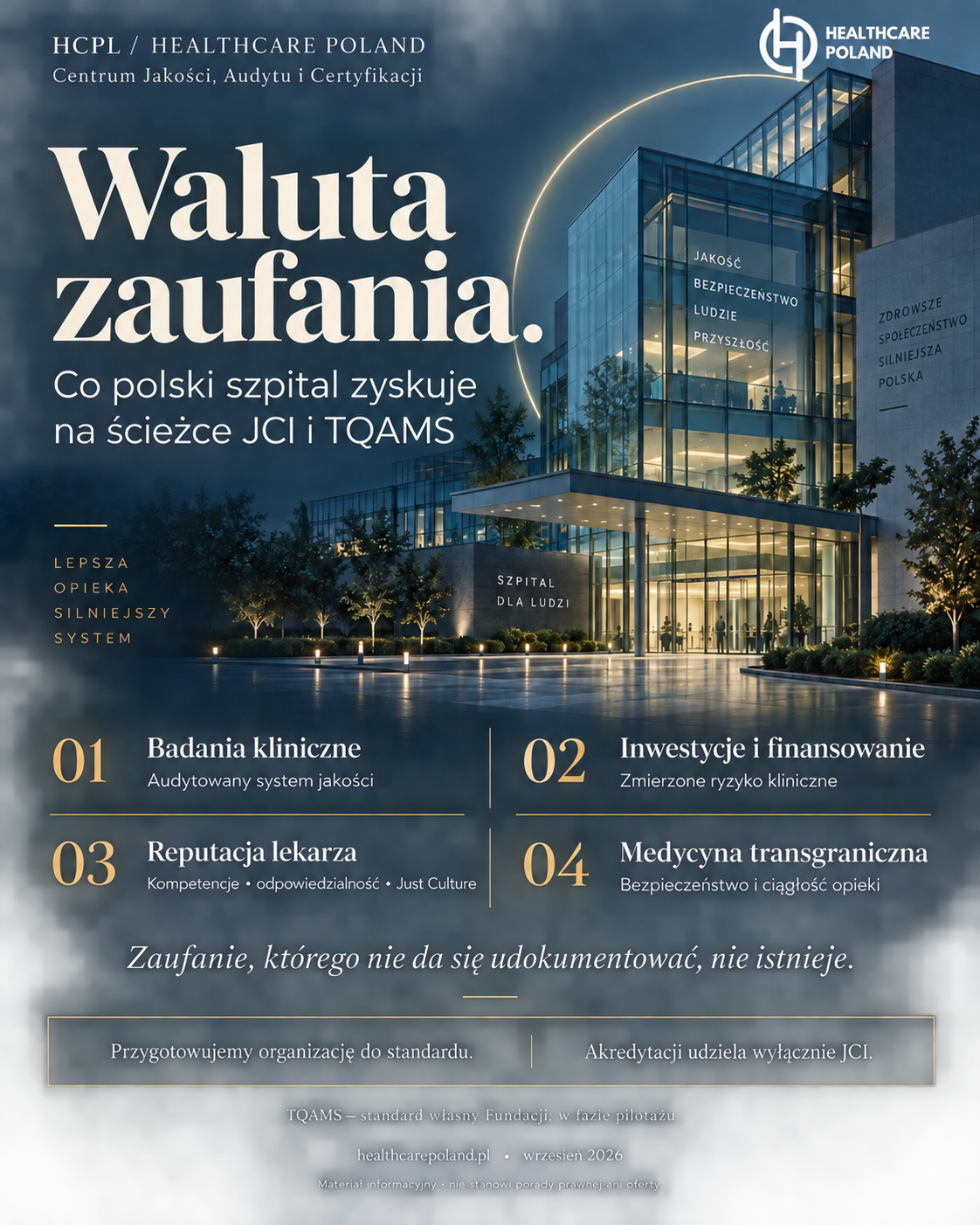
HCPL Centre for Quality, Audit and Certification
In 2026 the first hospital in Poland obtained Joint Commission International accreditation. A single event, but a threshold: the international standard can no longer be called out of reach in Polish conditions. The question has moved from “is it possible” to “what does a facility actually gain”.
Healthcare Poland Foundation · Centre for Quality, Audit and Certification · September 2026 · informational material, not legal advice or an offer
We prepare the organisation for the standard — accreditation is granted solely by JCI
Thesis
International accreditation is neither ornament nor hospital marketing. It is the instrument with which a facility pays for entry to four markets at once: clinical research, investment financing, cross-border care and medical travel. Each asks something different, but each requires the same answer — evidence that is external, repeatable and legible without knowledge of the Polish system.
Trust that cannot be documented does not exist.
Four markets, one proof
1. Clinical research
Since 23 July 2025 ICH E6(R3) has applied in the European Union for its principles and Annex 1; Annex 2, covering pragmatic and decentralised trials, applies from 15 January 2027. The guideline abandons checklist logic in favour of quality by design and oversight proportionate to risk. A site with a documented, audited system lowers the sponsor’s cost of oversight and enters trials on different terms. The JCI academic programme contains separate chapters on human subjects research (HRP) and medical professional education (MPE). Accreditation replaces no procedure under Regulation (EU) No 536/2014 — it reduces friction, it does not waive requirements.
2. Investment and financing
Clinical risk that cannot be measured is never priced gently: it costs a higher margin, tighter covenants or a lower valuation. An externally verified quality system with a measurement history moves talks with investors, lenders and insurers onto the ground of numbers. No financial institution requires a specific accreditation as a condition of financing — but the direction of expectations is unequivocal. The pathway is best started at least a year before a planned transaction.
3. Physician reputation
The JCI standard replaces presumption with record. Credentialing is verification of qualifications at source; privileging is a written, periodically reviewed scope of clinical privileges. For the physician this means portable proof of competence and a clear boundary of responsibility. The 8th edition introduces non-punitive reporting of sentinel events: Just Culture as an accreditation requirement, not a declaration.
4. Cross-border care and medical travel
Directive 2011/24/EU imposes on providers duties to inform patients about quality, safety and prices. Poland’s Act amending the National Cybersecurity System Act (Journal of Laws 2026, item 252) has applied since 3 April 2026. The EHDS Regulation applies from 26 March 2027; from 2029 it will cover the exchange of patient summaries and ePrescriptions, and from 2031 medical images, laboratory results and discharge reports. The Data Act has applied since 12 September 2025. Cross-border documentation is ceasing to be a PDF sent by email.
JCI’s 8th edition: the standard has caught up with European law
Since 1 January 2025 the 8th edition of JCI standards for hospitals and academic medical centres has applied. For the first time it sets out a chapter on health care technology — electronic records, telehealth and cybersecurity — and a chapter on patient safety, and from 1 January 2026 it introduces mandatory environmental requirements. The accreditation, digital and green pathways no longer diverge.
TQAMS — seven pillars in one audit
JCI accreditation is excellent evidence of clinical quality, but it does not answer questions about pricing in euros, translation of informed consent or contact with the patient three weeks after discharge. These questions are cross-border, not clinical. TQAMS — Transborder Quality Audit of Medical Services — assesses together:
- clinical processes and patient safety,
- cybersecurity and data protection (NIS2, GDPR, EHDS),
- multilingual documentation,
- informed consent conducted in the patient’s language,
- dispute resolution — complaint, mediation, arbitration,
- transparent pricing and insurance covering the foreign patient,
- continuity of care after the patient returns home.
For some facilities TQAMS is a goal in itself; for others, a stage before JCI. The common core of both pathways accounts for most of the organisational effort.
The role of the Healthcare Poland Foundation
The Healthcare Poland Foundation is the exclusive JCI-authorised and JCI-trained provider of JCI Services in the Republic of Poland, under a Collaborative Agreement with Joint Commission Resources, Inc. We prepare the organisation for the standard; accreditation is granted solely by JCI. Each element can be commissioned separately: executive briefing, readiness assessment and gap analysis, implementation programme, mock survey, transition package from national accreditation, training academy for quality managers.
The first conversation is not a service and carries no obligation. Services begin only once a written agreement is concluded.
Piotr Welenc, Director of the Centre for Quality, Audit and Certification — p.welenc@healthcarepoland.pl, +48 603 692 276 · Secretariat: global@healthcarepoland.pl, +48 787 000 827 · Enquiry form
- Act of 16 June 2023 on quality in healthcare and patient safety (Journal of Laws 2023, item 1692).
- Act of 23 January 2026 amending the National Cybersecurity System Act (Journal of Laws 2026, item 252).
- Directive 2011/24/EU; Regulations (EU) 2025/327 (EHDS), 2023/2854 (Data Act), 536/2014 (clinical trials).
- ICH E6(R3) — EMA.
- JCI, Accreditation Standards for Hospitals and Academic Medical Centers, 8th edition — JCI announcement.
- First JCI accreditation in Poland — Menedżer Zdrowia, July 2026.
The Healthcare Poland Foundation is independent of Joint Commission Resources, Inc. and Joint Commission International and is not their distributor, agent or representative. Conclusion of the Collaborative Agreement does not constitute an endorsement of the Foundation or its services by JCI. Advisory services are independent of accreditation — the Foundation makes no claims about their effect on the outcome of any accreditation process.
Accreditation under the Polish Act on quality in healthcare is granted by the minister responsible for health; accreditation of conformity assessment bodies by the Polish Centre for Accreditation. TQAMS is the Foundation’s proprietary standard developed within the GHSH ecosystem and is at pilot stage; it does not constitute ISQua, PCA or ministerial recognition. The law is stated as at September 2026.
HCPL-2026-CAC-002 · Healthcare Poland · Polska Federacja Szpitali · healthcarepoland.pl