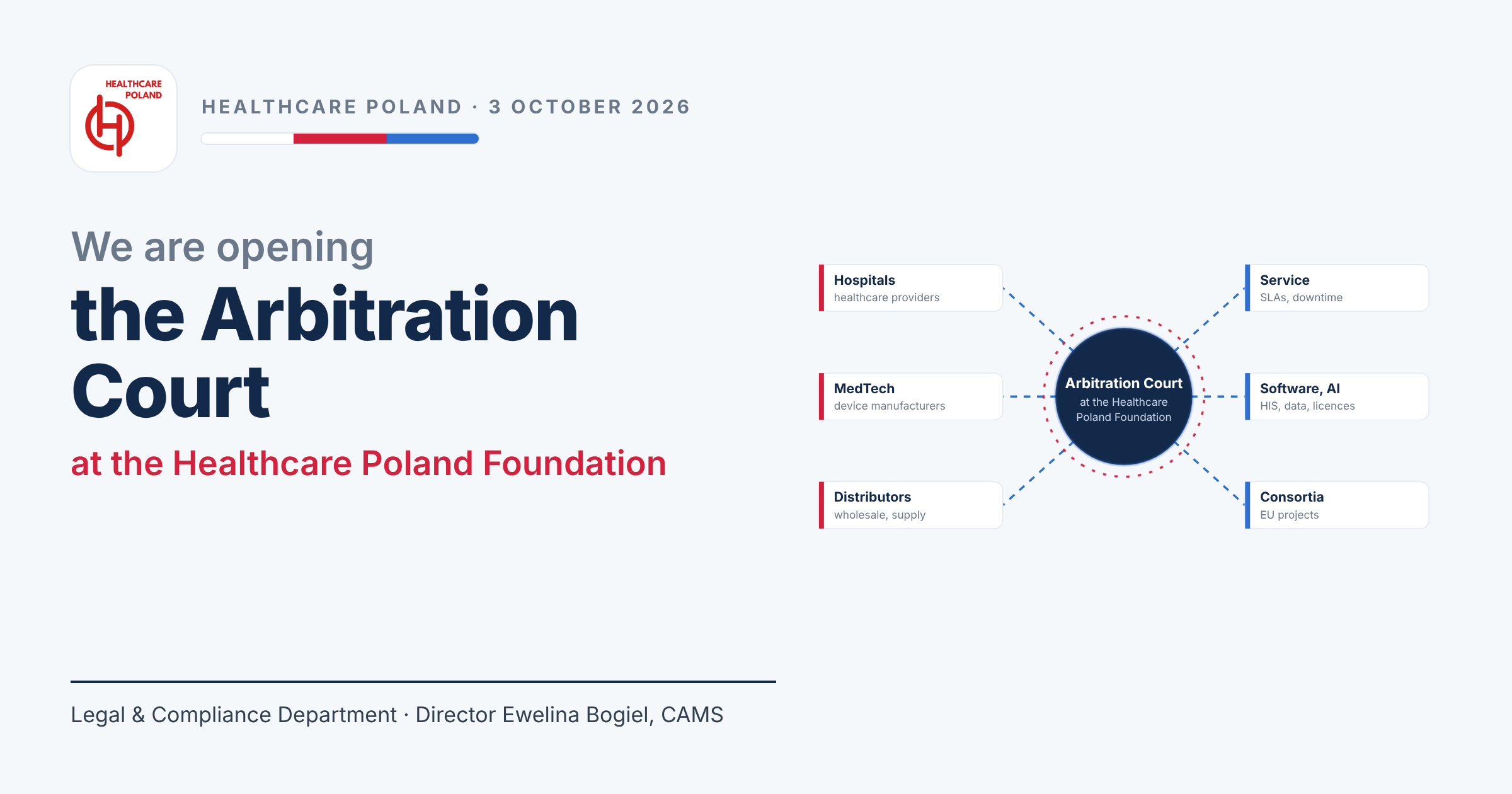
The Healthcare Poland Foundation opens an Arbitration Court within its Legal & Compliance Department — a sector forum for the amicable resolution of disputes between hospitals, medical device manufacturers, distributors and technology providers.
A dispute between a hospital and its supplier is not merely a legal incident. It is an event within the system of care: it stops equipment, delays deliveries, freezes receivables and takes management time that patients need. The Arbitration Court at the Healthcare Poland Foundation exists to resolve such disputes in weeks rather than years — with legal, clinical and technical expertise at the same time.
What we are opening today
As of 3 October 2026, the Healthcare Poland Foundation announces the establishment of the Arbitration Court at the Healthcare Poland Foundation. The Court operates within the Legal & Compliance Department, and the project is led by Ewelina Bogiel, CAMS — Director of the Legal & Compliance Department. The Court is part of the Centre for Mediation, Conciliation and Arbitration value stream, which combines three pathways of different legal weight: conciliation, mediation and arbitration.
The first area of activity is the Hospital–Supplier B2B track: disputes between healthcare providers and MedTech companies, distributors, service providers, software vendors and consortium partners. These disputes are purely commercial. Both parties are businesses, consumer restrictions do not apply, and an arbitration agreement can be included in the contract from the day it is signed.
The opening of the Court completes a structure the Foundation has been building across its value streams: from the Just Culture programme, through the TQAMS certification standard — in which alternative dispute resolution is one of eight pillars — to an eight-stage complaints procedure. Facilities that adopted these standards committed to having an amicable pathway. From today, they have a place to use it.
Why now: the empty band between a complaint and a lawsuit
Poland’s system for resolving healthcare disputes has two ends and an empty band in between. At one end is a complaint handled by the very organisation it concerns. At the other is litigation — costly, lasting years, dependent on expert opinions, and ending in a judgment that repairs nothing in the process.
Since 1 July 2024, the regional commissions for adjudicating medical events no longer operate. The Polish act on out-of-court resolution of consumer disputes excludes health services from its scope. The entire European ADR architecture, which covers banking, telecommunications and energy, has bypassed healthcare.
The second, less visible band consists of commercial disputes within the sector. Today a hospital buys not only equipment but availability: service with guaranteed response times, software integrated with the hospital information system, leasing billed per use, deliveries under public procurement rules. Each of these models creates an interface where a dispute can arise. Such disputes now go to common courts or general commercial arbitration, where arbitrators rarely know the reality of a hospital ward, MDR requirements or the specifics of a public procurement contract.
At the heart of most hospital–supplier disputes is not a legal provision but a fact: did the device work, who caused the downtime, was the contractual penalty due. That is why the Court’s pathway starts with an expert, not a lawsuit.
Which disputes the Court hears
| Area | Example of a dispute | Typical claimant |
|---|---|---|
| Performance of a public procurement contract | contractual penalties, delivery delays, price indexation, acceptance | supplier or hospital |
| Service and equipment availability | response time, downtime, spare parts, post-warranty service | hospital |
| Payments | arrears beyond the statutory term, interest, repayment schedule | distributor |
| Regulatory compliance | medical device status, incidents, corrective actions | both parties |
| Data and cybersecurity | data processing agreements, incidents in the supplier’s system, liability for consequences | hospital |
| Software, HIS and AI | licences, interoperability, data migration, system performance against specification | hospital |
| New cooperation models | leasing, pay-per-use, outcome-based contracts, grant consortia | both parties |
| Coordinated care | allocation of funds within an episode, continuity of care, consortium settlements | providers |
Who it is for
Public and private, including SP ZOZ units, hospital companies and network facilities. Parties to supply, service, licence and consortium agreements.
Equipment, implants, diagnostics. Disputes over acceptance, incidents, corrective actions and penalties — with experts who know the MDR.
Payment disputes, interest, instalment settlements and delivery terms — without breaking the client relationship.
Establishing who is liable for downtime before penalties accrue — through a neutral technical expert.
Licences, interoperability, data migration, GDPR and cybersecurity, model performance against specification.
Allocation of funds, rights to project results, settlements within care episodes and responsibility for continuity.
How the proceedings work
Level 00 — Prevention
The cheapest dispute is the one that never arises. Before a contract is signed, the Legal & Compliance Department provides the Court’s model clause, a review of SLA and acceptance terms, and training for procurement teams. Prevention is available on its own, with no obligation to use the further levels.
Level 01 — Technical review
A neutral expert from the Court’s list — a clinical engineer, a medical device specialist, an IT expert or a hospital economist — establishes the technical facts within a target of 14–30 days. The outcome is a findings report: an agreed description of the facts, not a ruling on fault.
Level 02 — Mediation
Contractual mediation under the Polish Code of Civil Procedure, conducted by a mediator from the Court’s list within a target of 30–90 days. A settlement approved by a common court has the force of a court settlement. In public procurement disputes, documented mediation satisfies the information requirement under Art. 593(1) of the Public Procurement Law.
Level 03 — Arbitration
Where agreement is not possible and the parties have concluded an arbitration agreement, the dispute is decided by the Arbitration Court at the Healthcare Poland Foundation within a target of 90–180 days. An arbitral award has the same legal force as a court judgment once recognised or declared enforceable by a court (Art. 1212 § 1 KPC). Without an arbitration agreement, the case goes to a common court — with a findings report that shortens the taking of evidence.
Benefits
For the hospital
- Disputes over downtime, acceptance or penalties resolved in weeks — with an expert who understands the equipment and the clinical process.
- Continuity of supply and service: the dispute does not stop cooperation or the work of the ward.
- A documented attempt at amicable resolution, as required by the Public Procurement Law.
- A model clause and SLA review before the contract is signed.
- Confidentiality — the dispute does not become a public or media matter.
- System-level lessons, without the parties’ data, that improve future contracts and tenders.
For the supplier
- Mediators, arbitrators and experts who know hospitals, the MDR and public procurement — not just the code.
- Faster recovery of receivables through settlement instead of years of litigation; important because a change of creditor of an SP ZOZ requires the consent of its founding body.
- Technical facts established by a neutral expert before contractual penalties accrue.
- The client relationship preserved — the dispute ends in a conversation, not a judgment against the hospital.
- Predictable cost: fees based on the value of the dispute.
- Confidentiality towards competitors and the market.
For the healthcare system
- Fewer cases in common courts and a shorter path to resolution.
- Just Culture extended to commercial relationships: distinguishing systemic error, negligence and reckless conduct.
- Knowledge of recurring causes of disputes — typical flaws in contracts, SLAs and specifications — returns to the sector as a standard.
The patient: what the Court does not change
The B2B track concerns disputes between businesses. In disputes with a patient, arbitration is available only on the basis of an agreement concluded after the dispute has arisen (Art. 11641 of the Polish Code of Civil Procedure). An arbitration clause in a consent form or in ward rules would be not only ineffective — it would contradict the very idea on which the Centre is built.
Participation is voluntary and does not close the way to the common courts, the Medical Events Compensation Fund, proceedings before the Patient Ombudsman, or professional liability proceedings. The Centre’s design was discussed at a meeting at the Office of the Patient Ombudsman. The Court does not replace the Ombudsman and does not compete with the Fund — it deals with what neither of these institutions covers.
Impartiality and governance
A dispute resolution body is measured by the trust of both parties at once. That is why the Court has a separate structure and transparent rules of recusal.
- No one who has audited, certified or advised either party decides that party’s case.
- The Court operates within the Legal & Compliance Department, separately from the Quality, Audit and Certification Centre.
- Programme fees paid by companies fund prevention and expert availability — never the outcome of a case.
- The B2B track’s programme council will have a parity composition: hospital and industry representatives, with an independent chair.
- The rules, the list of arbitrators and the fee schedule will be public and available on the Centre’s page.
Legal basis
| Provision | What it provides | Relevance for the Court |
|---|---|---|
| Art. 1157 Code of Civil Procedure (KPC) | Disputes over property rights may be submitted to an arbitration court. | The entire hospital–supplier portfolio is arbitrable. |
| Art. 1161 § 3 KPC | An arbitration agreement may designate a permanent arbitration court as competent to resolve the dispute. | Parties may designate the Arbitration Court at the Healthcare Poland Foundation in their contract. |
| Art. 1212 § 1 KPC | An arbitral award has the same legal force as a court judgment once recognised or declared enforceable by a court. | Once recognised or declared enforceable, the Court’s award works as a common court judgment. |
| Art. 11641 KPC | Arbitration agreements in consumer disputes — only after the dispute has arisen. | The restriction does not apply between businesses; it protects the patient. |
| Art. 1831 et seq. KPC | Mediation based on the parties’ agreement; a court-approved settlement has the force of a court settlement. | A mediation clause can be in the contract from the outset. |
| Art. 591(1) Public Procurement Law (PPL) | In a dispute arising from a contract, either party may request mediation or another amicable resolution. | The Court’s pathway is available for public procurement contracts. |
| Art. 593 PPL | A statement of claim states whether mediation was attempted; for contracts from EUR 10 million (supplies, services) and disputes above PLN 100,000, the court refers the parties to mediation. | Mediation at the Court documents the attempt at amicable resolution. |
| Art. 8(2) Act of 8 March 2013 on counteracting excessive delays in commercial transactions | Where the debtor is a public healthcare provider, the payment term may not exceed 60 days. | Payment disputes are recurrent — payment mediation and instalment settlements as standard. |
| Art. 54(5)–(6) Act on Medical Activity | A change of creditor of an SP ZOZ requires the founding body’s consent; an act without consent is null and void. | Settlements must respect this requirement; mediation is an alternative to assignment. |
| Regulation (EU) 2017/745 (MDR), GDPR, Directive (EU) 2022/2555 (NIS2) | Obligations of device manufacturers, data controllers and entities subject to cybersecurity rules. | Compliance disputes resolved with regulatory and IT experts. |
This overview is for information only and does not constitute legal advice.
Model clause
The model below shows the direction. The final wording of the clause will be published together with the Court’s Rules; until then, the Legal & Compliance Department advises on adapting it to a specific contract.
For contracts of public entities, the “mandatory mediation, optional arbitration” variant is recommended, agreed with the contracting authority’s legal counsel.
Timeline
How to get involved
Each element is available separately: the clause and contract review alone, a technical expert opinion alone, payment mediation, or the full package including arbitration. Hospitals, MedTech companies, distributors and technology providers interested in the pilot, a clause consultation or submitting a case can contact the Legal & Compliance Department.
More on the Centre’s design, its three pathways and the B2B track: Centre for Mediation, Conciliation and Arbitration.
- Polish Code of Civil Procedure of 17 November 1964, Art. 1831 et seq., Art. 1157, Art. 1161 § 3, Art. 11641, Art. 1212 § 1.
- Public Procurement Law of 11 September 2019, Art. 591 and 593; Public Procurement Office — conditions of mandatory mediation (in Polish).
- Act of 8 March 2013 on counteracting excessive delays in commercial transactions, Art. 8(2).
- Act of 15 April 2011 on Medical Activity, Art. 54(5)–(6).
- Act of 23 September 2016 on out-of-court resolution of consumer disputes; Directive 2013/11/EU.
- Act of 16 June 2023 amending the Act on Patient Rights and the Patient Ombudsman (Journal of Laws 2023, item 1675).
- Regulation (EU) 2017/745 (MDR); Regulation (EU) 2016/679 (GDPR); Directive (EU) 2022/2555 (NIS2).
- Centre for Mediation, Conciliation and Arbitration — Healthcare Poland Foundation.