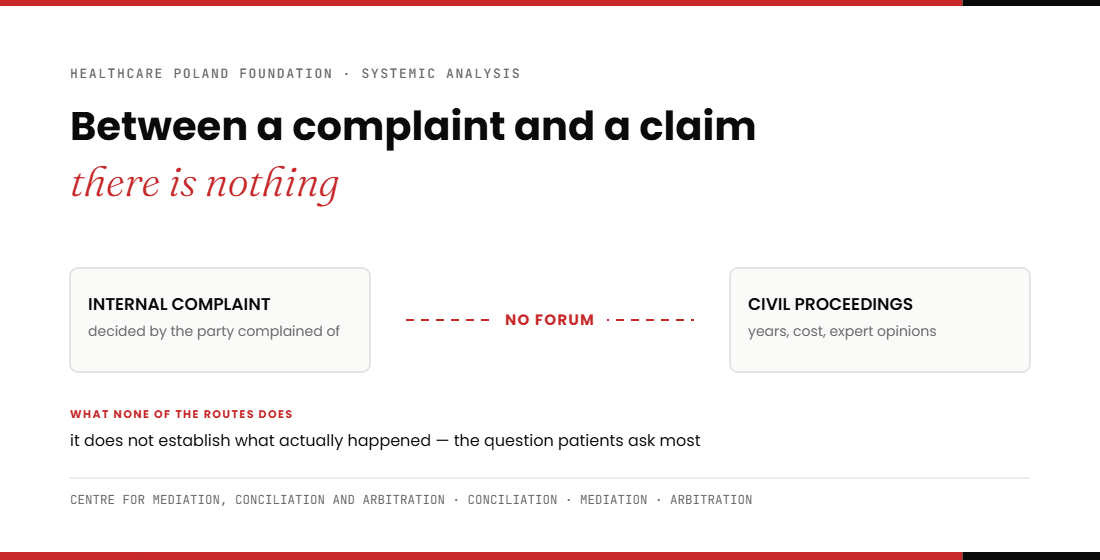
Between a complaint left at the front desk and a claim filed in civil court, a Polish patient has nowhere to go. Since 1 July 2024 there is not even a regional commission. This is an account of the gap, what it costs hospitals, and the design of the Centre for Mediation, Conciliation and Arbitration intended to close it.
Since 2024 the Polish system requires healthcare providers to learn from adverse events while giving them no forum in which the relationship with the patient can be closed by any means other than a judgment or silence. Compensation without explanation does not end a case — it merely prices it.
A gap nobody designed
The regional commissions for adjudicating medical events ceased to exist on 1 July 2024. They were abolished by the same statute that created the Medical Events Compensation Fund — the amendment of 16 June 2023 to the Act on Patients’ Rights and the Patient Ombudsman. The commissions were to conclude pending matters by 30 June 2024; close to 370 unfinished cases passed to the Patient Ombudsman.
The substitution was not one for one. The commission, for all its shortcomings, conducted a proceeding to establish facts: it ruled on whether a medical event had occurred. The Fund conducts a proceeding to award a benefit. These are two different operations, and the system retained only one of them.
Four routes, and what none of them does
A patient who believes something went wrong has four routes available. Each was designed for a different purpose, and none answers the question patients ask most often — what actually happened.
| Route | What it delivers | What it does not | Constraints |
|---|---|---|---|
| Internal complaint at the provider | Fast response, scope for an apology, process correction | Decided by the party complained of — no independence | No binding force; the patient has no guaranteed sight of the findings |
| Medical Events Compensation Fund | A benefit without proof of fault, on a no-fault model; decision typically within months | Does not explain causes and creates no obligation to change practice | Publicly financed hospital care; accepting an award requires a waiver of claims for harms disclosed by the filing date |
| Mediation before the medical chamber | Genuinely effective — close to 60% of referred cases settle | Concerns a physician’s professional liability, not the patient–provider relationship | Fewer than 1% of cases are referred to it |
| Civil proceedings | A binding determination and full compensation for loss | Years, cost, expert opinions, strain on both sides | Burden of proof on the patient; the relationship ends in a dispute, not an explanation |
Routes available to patients in Poland, as at September 2026. Healthcare Poland Foundation analysis.
What is missing from the list matters. The consumer ADR system built on the Act of 23 September 2016 operates through sectoral authorised entities entered in the register kept by the President of the Office of Competition and Consumer Protection — for energy, telecommunications, financial services, insurance and transport. No such entity exists for healthcare. The Act further excludes from its scope disputes concerning services of a non-economic character provided in the general interest (art. 5(5)(a)), which closes the route formally for a substantial part of publicly financed care.
The quality act creates a duty to learn — but no forum
Since 30 June 2024, providers operating under a contract with the National Health Fund have maintained an internal quality and patient-safety management system under the Act of 16 June 2023 on quality in healthcare and patient safety. The system covers identification, reporting and analysis of adverse events, and the implementation of corrective measures.
The legislature built protection around the report: as a rule, reporting an adverse event cannot found criminal or disciplinary proceedings against the reporter, save for intentional acts. This is Just Culture written into statute — a reporting culture works when reporting does not cost the reporter a career.
That protection does not extend to the patient’s civil claim, and rightly so — nobody removes the patient’s access to the courts. But it creates a tension the system leaves unresolved. The hospital is required to establish what happened and to draw conclusions. The patient is entitled to know what happened. And between the two there is no place where they can meet without the risk that the conversation becomes evidence.
This paper describes a concept in design, not an operating institution. The mediation figures cited for professional-liability proceedings come from research reported in the sector press and are not official annual statistics. The scope of the Compensation Fund in relation to care delivered outside inpatient hospital settings remains a matter of doctrinal dispute.
What the Centre is
The Centre for Mediation, Conciliation and Arbitration is a sectoral body for the amicable resolution of healthcare disputes, being built by the Healthcare Poland Foundation. Its design has three tiers and deliberately begins with the lightest instrument.
Conciliation — establishing facts before a dispute forms
A fact-finding procedure conducted by an independent conciliator with both clinical and legal competence. The output is not a judgment but a description of the event: what happened, what departed from standard, what the provider changed. For many patients that is precisely what they came for.
Mediation — agreeing the terms on which the relationship closes
Mediation conducted under the Code of Civil Procedure, with the option of court approval of the settlement. The subject matter is not only money, but also an apology, a change of procedure, and feedback on the corrective measures actually implemented.
Arbitration — a binding determination, where it is legally available
A permanent arbitral tribunal for disputes in which both parties are undertakings — provider and supplier, provider and insurer, consortium and subcontractor. In the relationship with a patient, arbitration remains an exceptional and statutorily constrained instrument, as set out below.
- Independence of the decision-maker — conciliator and mediator from outside the provider’s structure, with declared conflicts of interest.
- Confidentiality of the proceeding, without closing the patient’s access to the courts.
- Clinical competence in the chair — a medical case requires an understanding of medicine, not only of procedure.
- Findings linked to the provider’s internal quality system, so that conclusions return to the process rather than to a binder.
- Availability where the Compensation Fund does not reach — in outpatient specialist care and primary care.
The legal constraints that shape the design
Three provisions of the Code of Civil Procedure mark the limits of what can be built, and the Centre’s three tiers follow from them.
Article 1157 CCP — disputes over pecuniary rights, and over non-pecuniary rights capable of being settled in court, may be submitted to arbitration. That delimits the subject matter: claims for damages and for compensation for harm fall within it, but not every demand a patient makes is of a kind that can be resolved this way.
Article 11641 CCP — an arbitration agreement covering disputes arising from contracts involving a consumer may be concluded only after the dispute has arisen and must be in writing. No arbitration clause in a set of rules or a consent form will therefore bind a patient. Arbitration in the patient relationship is possible solely as an informed decision taken after the event — and only that model is available to the Centre.
Article 1163 CCP — an arbitration clause in the articles of association of a commercial company binds the company and its shareholders in disputes arising from the company relationship. That provision concerns commercial companies; it does not extend to an employers’ association. Consequently, writing arbitration into the statute of a sector organisation will not bind its members. A separate written accession by each entity to the Centre’s rules is required — and that is how the mechanism is being designed.
Why the Polish Hospital Federation provides the umbrella
A solution of this kind does not work at the scale of a single hospital. Patients do not know the name of a mediation body — patients know the name of the hospital. For the mechanism to be recognisable, and for the standard of procedure to be comparable between providers, a national umbrella organisation is required.
The Polish Hospital Federation, led by Prof. Jarosław J. Fedorowski, has approximately 250 directly affiliated members and, together with umbrella organisations including regional hospital associations, reaches close to 520 hospitals. The second figure describes the real reach of the standard if it is adopted as a federation recommendation.
For a member hospital the Centre is then a pro-patient service ready for implementation: an element of demonstrable compliance with the quality act, an instrument that reduces the number of matters escalating to litigation, and evidence that a declared just culture has a procedural counterpart. The Federation already runs a separate programme devoted to just culture; the Centre is its natural extension outward from the organisation, towards the patient.
Where the work stands
The project is led for the Healthcare Poland Foundation by Ewelina Bogiel, advocate, CAMS, Director of Legal & Compliance, and Maria Łabno. The assumptions were consulted at the Office of the Patient Ombudsman. Completed to date: the three-tier model, the analysis of statutory constraints, the institutional design, and a statement of benefits set out separately for hospitals and for patients.
Ahead of us are the rules of procedure, the panel of conciliators and mediators with selection criteria, the tariff, and a pilot among providers who declare readiness. We invite hospitals, patient organisations and insurers to take part — this mechanism is only worth building if its rules are written with all three parties in the room.
Participation is voluntary and does not close access to the courts. It does not replace an application to the Medical Events Compensation Fund or a complaint to the Patient Ombudsman. It does not limit professional-liability proceedings. The only undertaking the patient gives is confidentiality as to the conduct of the proceeding itself — and only for its duration.
- Act of 16 June 2023 amending the Act on Patients’ Rights and the Patient Ombudsman and certain other acts (Journal of Laws 2023, item 1675) — creation of the Medical Events Compensation Fund; abolition of the regional commissions with effect from 1 July 2024.
- Act of 16 June 2023 on quality in healthcare and patient safety (Journal of Laws 2023, item 1692) — internal quality and safety management system, adverse-event reporting, protection of the reporter.
- Act of 17 November 1964 — Code of Civil Procedure: art. 1831 et seq. (mediation), art. 1157, art. 1163, art. 11641 (arbitration agreements, agreements involving a consumer).
- Act of 2 December 2009 on medical chambers, art. 113 — mediation in professional-liability proceedings.
- Act of 23 September 2016 on out-of-court resolution of consumer disputes (Journal of Laws 2016, item 1823), in particular art. 5(5)(a).
- Directive 2013/11/EU on alternative dispute resolution for consumer disputes, and Directive 2011/24/EU on the application of patients’ rights in cross-border healthcare.
- Figures on the scale of mediation in physician professional-liability matters after Prawo.pl, “Mediacje w sprawach lekarskich nadal rzadkie, bo nie mają realnego wpływu”. Figures on cases transferred from the regional commissions — Office of the Patient Ombudsman, after Prawo.pl.
Michał P. Dybowski — President of the Management Board of the Healthcare Poland Foundation; CSO and Director of the Green Hospitals and Safety Department at the Polish Hospital Federation. This paper was prepared as part of the Foundation’s work on the Centre for Mediation, Conciliation and Arbitration. Contact regarding the Centre: centrum@healthcarepoland.pl.