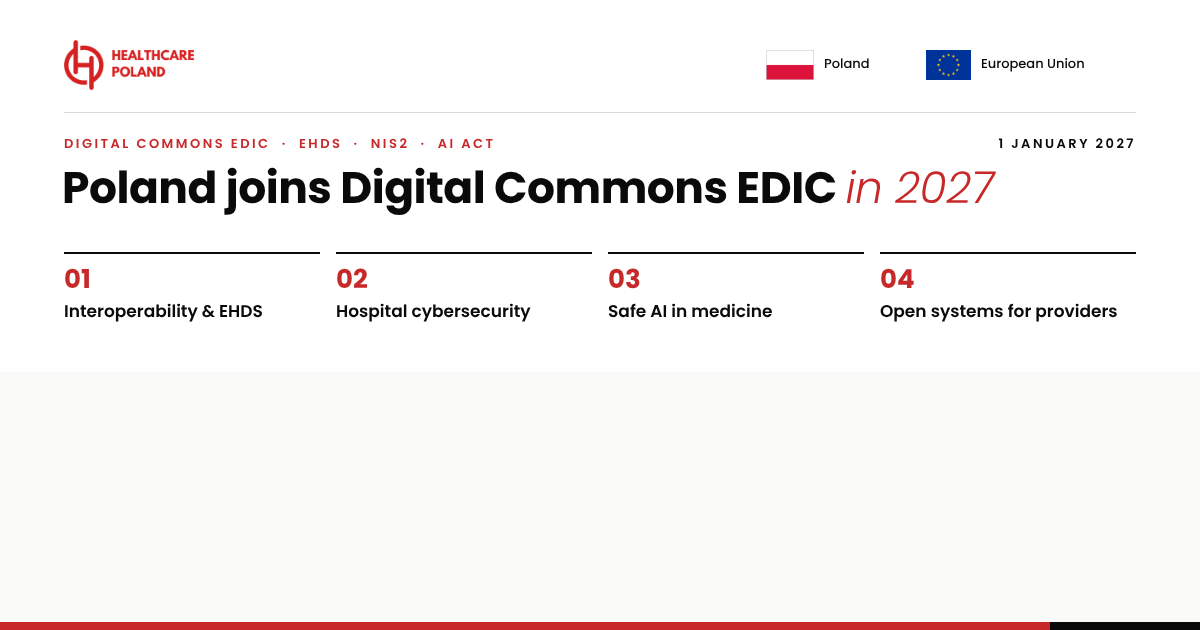
On 16 October 2026 the Assembly of Members of Digital Commons EDIC endorsed Poland’s application. From 1 January 2027 Poland will be a full member of the European consortium that jointly develops, deploys and maintains open technologies for the public sector. Poland will be represented by the Ministry of Digital Affairs.
At first glance this is news for public administration and the IT sector. From a healthcare perspective, however, it is one of the most significant decisions of this autumn — because it touches problems Polish hospitals face every day.
What Digital Commons EDIC is
An EDIC (European Digital Infrastructure Consortium) is an EU legal form through which Member States jointly deliver digital projects of European relevance. Digital Commons EDIC focuses on “digital commons” — above all open-source software — that many institutions can use. Its full members include the Netherlands, Germany, France, Luxembourg and Italy; until now Poland took part as an observer.
According to the Ministry of Digital Affairs, membership gives Poland influence over the consortium’s direction, easier access to proven solutions for public administration, cooperation in deploying and maintaining them, and new opportunities for the Polish ICT sector.
A problem every hospital director knows
Polish hospitals operate in a model where each provider buys, integrates and maintains its systems largely on its own. The consequences are predictable:
- vendor lock-in — changing systems is costly and risky, so it often never happens;
- high maintenance costs — the same functions are bought and serviced hundreds of times over;
- difficult data exchange — between hospitals, with primary care and with national systems;
- rising security requirements — which smaller facilities cannot meet alone.
At the same time regulatory pressure keeps growing. Poland’s amended National Cybersecurity System Act has applied since 3 April 2026. The European Health Data Space (EHDS) Regulation will apply from 26 March 2027 and will gradually cover cross-border exchange of patient summaries and e-prescriptions, followed by laboratory results, medical imaging and discharge reports. On top of that come the AI Act requirements for artificial intelligence systems used in medicine.
What the digital commons logic changes
Digital Commons EDIC rests on a simple premise: some technologies are better built once — jointly and openly — than bought many times over in closed form. In healthcare we see at least four areas where this logic makes particular sense.
1. Interoperability and EHDS
Open data-exchange components, reference implementations of standards and validation tools can lower the cost of EHDS readiness for all providers at once — instead of paying for the same work in every hospital separately.
2. Hospital cybersecurity
Jointly maintained tools for protection, monitoring and incident response give smaller facilities access to a level of security they could not afford on their own.
3. Safe AI in medicine
Open tools for assessing, testing and documenting AI systems in line with the AI Act can become shared trust infrastructure, rather than being rebuilt by every hospital and every vendor.
4. Open systems for healthcare providers
Solutions a hospital can deploy, develop and maintain without being locked in to a single vendor — with public code, an open licence and transparent governance.
Where Healthcare Poland Foundation stands
This is the direction we have worked in from the start. We are the Polish partner in HeliX, a project funded under Horizon Europe (Grant Agreement No. 101228287) that addresses, among other things, interoperability and the use of health data in the spirit of EHDS. We develop open solutions for hospitals and work on the cybersecurity of healthcare facilities and on the safe, compliant deployment of AI in healthcare.
We do this together with the Polish Hospital Federation (PFSz), because member hospitals know best what they actually need — and they are the ones who should benefit from European cooperation.
What Digital Commons EDIC does not change
Due diligence requires a clear caveat. Poland joining the consortium does not replace the rules that apply to healthcare IT systems: integration with the national P1 platform, cybersecurity requirements, personal data protection, the upcoming EHDS requirements for electronic health record systems, or medical device legislation. Every solution deployed in a hospital must meet them, whether it is open or not.
What Digital Commons EDIC does provide is a framework in which open, shared solutions stop being a niche and become a direction of public policy. That is an important shift in perspective for the entire sector.
What we propose
We believe healthcare should be one of the areas of Poland’s participation in Digital Commons EDIC. We are ready to work with the Ministry of Digital Affairs and the Ministry of Health on:
- identifying hospital needs that are worth addressing with shared, open solutions;
- pointing to existing initiatives — including European projects — that can add value to Poland’s portfolio;
- preparing the sector to use these solutions: from requirements, through pilots, to deployment in PFSz member hospitals.
Join the conversation at IGF Poland 2026
We will discuss how openness, interoperability and security come together in healthcare on 20 October 2026 at 9:00 at the IGF Poland 2026 Digital Summit (Senate Hall), in the Healthcare Poland Foundation session “Digital Shield for Health” („Cyfrowa tarcza zdrowia”). You are welcome to join us.
Source on Poland’s accession: Ministry of Digital Affairs announcement, 16 October 2026 (in Polish).
This article is for information purposes and expresses the position of Healthcare Poland Foundation. It is not a statement or position of the Ministry of Digital Affairs, the Ministry of Health or Digital Commons EDIC. As of 19 October 2026.
Healthcare Poland Foundation | Polish Hospital Federation