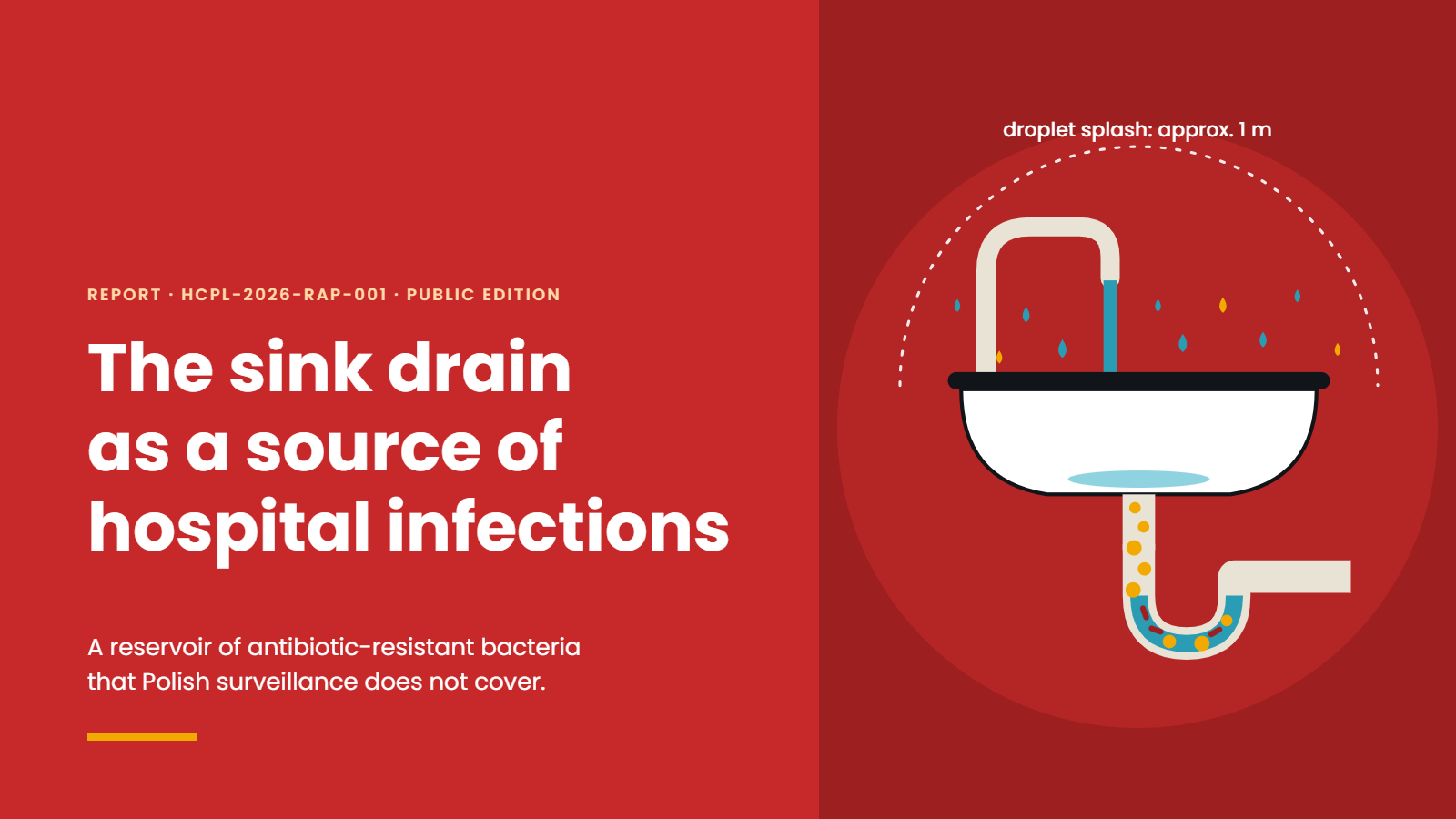
The Healthcare Poland Foundation has published the report “The Sink Drain as a Source of Hospital-Acquired Infections” (HCPL-2026-RAP-001, public edition, November 2026). The collective study, led by Michał P. Dybowski, runs to 78 pages: it organises twenty years of literature, sets it against data from ECDC and the Polish State Sanitary Inspectorate, describes the legal framework binding on the hospital director, and closes with fifteen graded recommendations.
Sink drains in Polish hospitals should be brought into the infection prevention system on the same terms as surfaces, equipment and staff hands.
A gap in the prevention of hospital-acquired infections
In Poland, the prevention of hospital-acquired infections rests on three pillars: hand hygiene, decontamination of surfaces and equipment, and isolation of carriers. The report identifies a gap in this arrangement. The trap and waste pipe are a persistent reservoir of multidrug-resistant Gram-negative bacilli, including carbapenemase-producing strains (CPE). The reservoir re-establishes itself after every disinfection, and bacteria reach the patient through droplet splash within a radius of about one metre. The national surveillance system does not test, record or report this source.
Scale: the 2030 target is moving further away
- 5.15 bloodstream infections caused by carbapenem-resistant Klebsiella pneumoniae per 100,000 population in 2024 (ECDC), against 1.38 in 2019 and a 2030 target of 1.32 set by the EU Council Recommendation of 13 June 2023.
- 307 hospital outbreaks of K. pneumoniae in 2025, against 249 a year earlier (State Sanitary Inspectorate).
- 22,077 infections with carbapenem-resistant bacilli reported in 2025.
Those most exposed are haematology and oncology patients and patients in intensive care, transplant, neonatal and burns units.
Order and measurement first, technology last
The fifteen recommendations share one axis: action begins with inventory and measurement, and technology enters only once measurement has shown a reservoir and basic measures have not reduced the number of acquisitions. Among other things, the report recommends including sinks and drains in the infection risk assessment conducted by the hospital director, taking an inventory of water points on the highest-risk wards within six months, sampling drains in every CPE outbreak, and introducing trap-level technologies first as a pilot with a failure criterion set before the start.
The duty to assess infection risk and to carry out internal control arises from the Polish Act on Preventing and Combating Infections and Infectious Diseases in Humans. Drains fall within that duty without any change to the law.
Limits of the evidence and technology neutrality
The study separates what is established from what is promising. Design changes give the most durable effects, chemical and thermal disinfection works only temporarily, and trap-level engineering solutions are promising, although most studies come from a single centre. The share of this route in the overall number of infections remains unknown, and the report says so plainly. Its scenario model estimates that controlling drains on anaesthesiology and intensive care wards would avert about 160 bloodstream infections and about 40 deaths a year in Poland. This is an estimate that a pilot is meant to confirm or refute.
The report is technology-neutral: it assesses principles of operation and the quality of evidence, and names no products or suppliers. The Healthcare Poland Foundation does not sell or distribute devices.
Where to read the report
A full overview of the report, with the data, the mechanism diagram and the implementation pathway, is available on the page Report: The Sink Drain as a Source of Hospital-Acquired Infections. The full edition is available in Polish and can be ordered free of charge; the order form is in Polish.