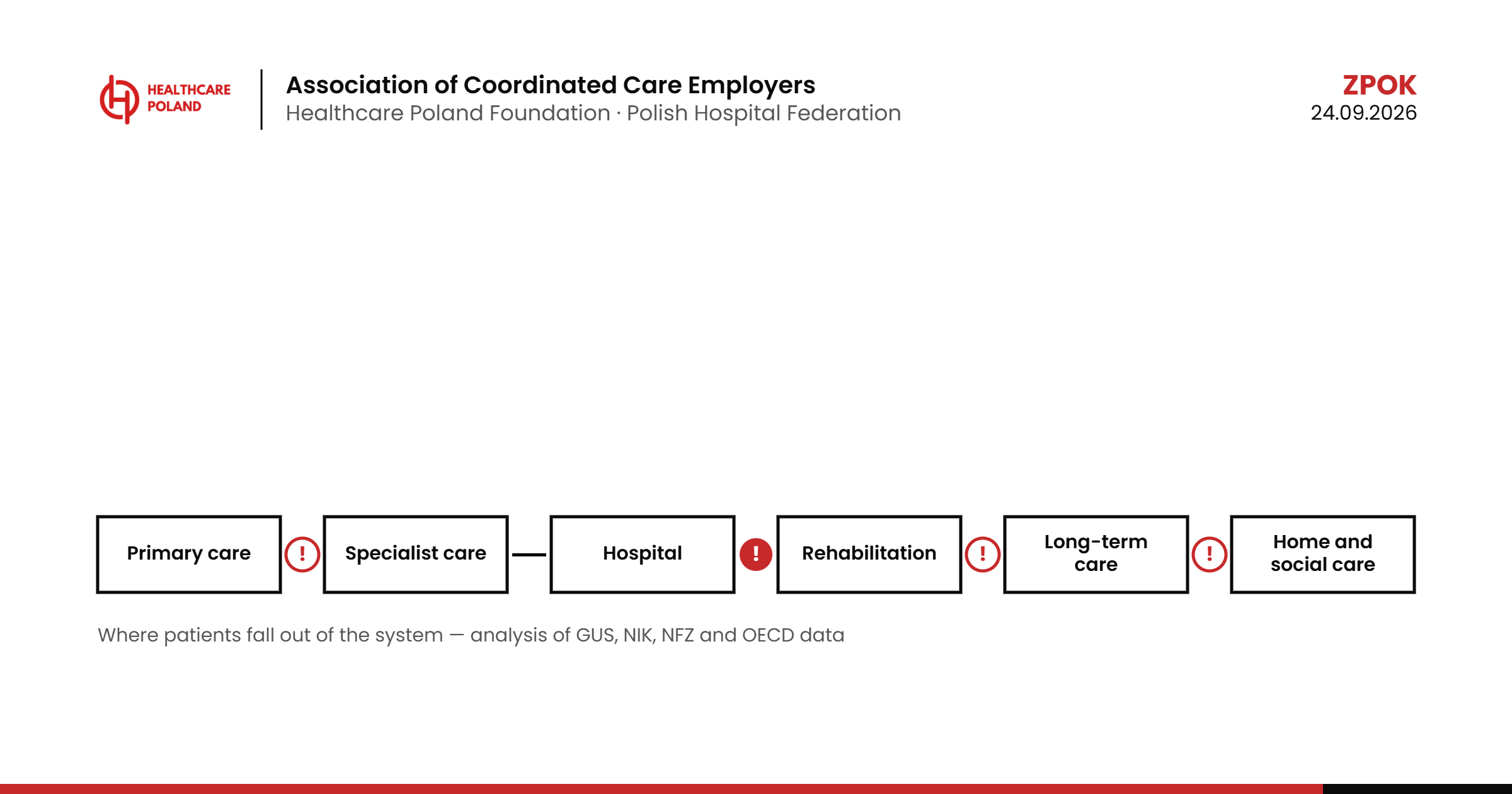
The Association of Coordinated Care Employers (ZPOK) was not born of institutional ambition. It was founded because public data — from Statistics Poland (GUS), the Supreme Audit Office (NIK), the National Health Fund (NFZ), the OECD and the European Observatory on Health Systems and Policies — has for years described the same gap: the Polish healthcare system treats patients effectively within each link of care, but loses them at the interfaces between the links. This analysis brings those sources together and draws from them the conclusion that on 24 September 2026 became a founding act.
I. Thesis
Continuity of care is not a property of a facility. It is a property of the chain. A hospital may deliver care of the highest standard, and the patient will still lose its benefit if, after discharge, they wait months for rehabilitation, for a place in long-term care or for information to return to their family doctor. A break in the patient’s trajectory rarely occurs within a link — it occurs at the interface. And in Poland today these interfaces have no owner: no employers’ organisation has so far represented all the links through which a patient passes at the same time.
The data below show that this gap has three dimensions: demographic (the number of patients whose pathway by definition passes through many links is growing), structural (the system is hospital-centred and under-invested outside the hospital) and operational (documented breaks after discharge, in rehabilitation and in long-term care).
II. The demographic dimension — the multi-link patient is becoming the rule
According to the Statistics Poland (GUS) population projection for 2023–2060, Poland’s population will fall from about 37.8 million (end of 2022) to 32.9 million in 2060, i.e. by 12.7%. Over the same period the number of people aged 65 and over will rise from about 7.4 million to about 9.9 million — by 34.2% — and they will make up about 30% of the population. The number of people aged 80 and over is expected to double: from about 1.7 million to about 3.5 million. The old-age dependency ratio will rise from 72.2 to 96.3.
The significance of these figures for the organisation of care is direct. A patient aged 80+ is rarely a patient of a single service. Their pathway includes the family doctor, the specialist, hospitalisation, rehabilitation, often long-term or home care and social support. Each of these links today operates under its own contracting rules, its own IT systems and its own waiting lists. Demography therefore shifts the centre of gravity of the system from the individual service to the transition between services.
III. The structural dimension — a hospital-centred system
The health profile of Poland prepared by the OECD and the European Observatory on Health Systems and Policies for the European Commission (State of Health in the EU. Poland: Country Health Profile 2025) describes a spending structure that entrenches fragmentation:
Show data as a table
| Indicator (year) | Poland | EU average |
|---|---|---|
| Health spending per capita (2023) | EUR 2,266 | EUR 3,832 |
| Health spending, % of GDP (2023) | 7.2% | 10% |
| Share of inpatient care in current spending (2023) | 37.2% | 27.7% |
| Share of long-term care in current spending (2023) | 7.8% | 18.1% |
| Share of prevention in current spending (2023) | 1.7% | 4% |
| Hospital beds per 1,000 population (2023) | 6.3 | 5.1 |
| Nurses per 1,000 population (2023) | 5.9 | 8.5 |
| Doctors per 1,000 population (2023) | 3.9 | 4.3 |
| Unmet medical needs (2024) | 5.2% | 3.6% |
The authors of the profile state explicitly that spending in Poland favours inpatient over outpatient care, and that the low share of long-term care reflects a continued reliance on unpaid, informal family care and a lack of formal long-term care provision. The profile also notes a high level, compared with the EU, of avoidable hospital admissions for congestive heart failure — precisely the category of admissions that effective post-discharge coordination prevents.
The analytical conclusion is clear: Poland has relatively many hospital beds and relatively few resources in the links that should take over the patient after hospitalisation. The hospital thus becomes the place where the system “stores” a patient for whom it cannot secure the next stage of care.
IV. The operational dimension (1) — the gap between discharge and rehabilitation
In its report on the audit of medical rehabilitation (published on 23 December 2021), the Supreme Audit Office (NIK) found that just over 26% of stroke patients received rehabilitation within 14 days of the end of hospital treatment, and that within 90 days rehabilitation was started by between 34% and 47% of patients, depending on the region. Only just over 14% of stroke patients started rehabilitation with the same provider at which they had been hospitalised.
NIK also identified the systemic cause: the lack of a platform for exchanging information on patient treatment that would enable coordinated care, and the lack of a uniform system for financing rehabilitation across the NFZ, the Social Insurance Institution (ZUS), the Agricultural Social Insurance Fund (KRUS) and regional occupational medicine centres. As many as 90% of the audited entities reported a loss on this activity.
Stroke is a model example, because the outcome of treatment depends on when rehabilitation begins. Every week of delay means a loss of function that cannot be recovered later — and a cost that shifts to the family, social assistance and the disability assessment system.
V. The operational dimension (2) — the long-term care gap
In its audit “Availability of long-term care financed by the NFZ” (P/19/061, published in October 2020, covering 2017 to the first half of 2019), NIK found that in 10 audited entities patients waited more than 100 days for placement in a facility. In Bydgoszcz the average waiting time rose from 223 to 494 days, and in Toruń from 522 to 721 days. In the audited entities, a total of 1,296 people were removed from waiting lists because they had died — against about 1,600 patients staying in those facilities during a year. People over 65 accounted for 84.5% of patients.
These data pre-date the pandemic and the current acceleration of population ageing. Taken together with the GUS projection (a doubling of the number of people aged 80+) and the share of long-term care in spending (7.8% against 18.1% in the EU), they show that the gap is not incidental but structural — and will keep growing.
VI. Coordinated care in primary care — real progress and its limit
Coordinated care in primary care is a reality in Poland. According to NFZ data published in September 2026, 55% of primary care practices have coordinated care contracts, covering about 23 million patients, and the total value of contracts in 2022–2026 is about PLN 2.76 billion (over PLN 960 million in 2026).
This achievement confirms that the coordination model works. It also shows its limit: coordination organised around primary care ends where primary care ends. The delegated budget and the coordinator in the practice do not cover the patient’s pathway through hospital, rehabilitation, long-term care and home. Employers’ organisations representing coordinated care today mainly represent the primary care segment. The other links — including those where NIK documents the largest breaks — have had no common voice.
VII. The legal dimension — the legislator already requires continuity
Three parallel legal regimes impose obligations on providers that cannot be fulfilled without coordination across the boundaries of a single entity:
- National Oncology Network. The amended Act on the National Oncology Network, in force since 11 August 2026, introduces a definition of continuity of oncology care as a coordinated process of providing health services, quality indicators verified by the NFZ and the qualification of centres to the network in 2027.
- Directive 2011/24/EU on patients’ rights in cross-border healthcare. Article 4(2)(b) requires healthcare providers to provide information on treatment options, availability, quality and safety of care and clear information on prices.
- European Health Data Space (EHDS) — Regulation (EU) 2025/327. It introduces cross-border exchange of, among others, medical images, laboratory results and hospital discharge reports, which requires interoperability at the interface of all links.
Each of these regimes shifts the burden of proof onto the provider: it is the provider that must demonstrate continuity, availability and data readiness. None, however, gives providers a common tool or common representation before the regulator.
VIII. Conclusion — the missing actor
The sources lead to a single conclusion: the Polish healthcare system needs representation of employers across the entire chain of care, not another representation of a single link. Such representation must take a form that gives real participation in rule-making. This is why ZPOK was established as an employers’ organisation under the Act of 23 May 1991 on Employers’ Organisations — a form that is a statutory party to social dialogue and legislative consultation, not merely an advisory voice.
ZPOK brings together employers in primary care, outpatient specialist care, hospital care, rehabilitation, long-term and palliative care, diagnostics, home and community care, telemedicine, health and personal assistance and social assistance (§ 7 of the Statute). It works in a complementary way with organisations representing the primary care segment — bringing into the dialogue the links that were missing from it.
IX. What the Association will do
- READY 24/7 — a programme that turns declared availability of services into documented availability. It measures the time from need to service, not the equipment owned. The Resource Map method describes a resource in seven dimensions (resource, staff, supplies, time, data, billing basis, foreign patient pathway); the product is the Resource Readiness Card, owned by the provider. The pilot covers diagnostic imaging (PET-CT, contrast-enhanced MRI). The programme is neither an audit nor a ranking.
- Value-based financing — positions on financing entire episodes of care and common quality indicators for the chain from primary care through specialist care, hospital and rehabilitation to long-term care.
- Continuity at the interfaces — standards for patient handover at the points NIK identifies as critical: discharge → rehabilitation, hospital → long-term care, hospital → home.
- Integration of health and social care — cooperation with social welfare homes (DPS), social assistance centres (MOPS, PCPR), care services and personal assistance.
- Digital continuity, communication and sovereign connectivity — interoperability and EHDS readiness, cybersecurity (NIS2), communication between links and with patients through secure channels with data kept in Polish and EU jurisdiction, and redundant communication channels that maintain patient handover and home care when the public network fails.
- Social dialogue and legislative opinions — with the Ministry of Health, the NFZ, AOTMiT, the Ministry of Family and Social Policy and the Patient Ombudsman.
- 24.09.2026Founding act of ZPOK signed (AMOZ XI)
- by 24.10.2026Application for registration in the National Court Register (Art. 9(2) of the Act)
- 31.10.2026READY 24/7 pilot: PET-CT and contrast-enhanced MRI
- 19.12.2026Resource Readiness Card 1.0 — first Cards issued
- 31.03.2027Extension to all links of the chain
- 30.06.2027Patient trajectory map — report for the Ministry of Health and the NFZ
X. Principles
A declaration of availability that nobody verifies shifts the cost of uncertainty onto the patient — it is the patient who waits without knowing what they are waiting for. Justice in a healthcare system begins by shifting that cost to where the capacity to bear it lies: to the institution that knows its own resources and its own response time. ZPOK adopts the principles of transparency, proportionality, responsibility and solidarity. In the spirit of Just Culture, it treats a break in continuity of care as information about the system that must be repaired, not as a fault to be defended.
XI. Establishment, statute and membership






The founding act of the Association was signed on 24 September 2026 in Warsaw, during the 11th Healthcare Manager Academy (AMOZ XI). The Founding Meeting adopted the Statute and appointed the Founding Committee composed of Prof. Jarosław J. Fedorowski, Zbigniew Torbus, Michał P. Dybowski, Daniel Nowocin and Sławomir Nawrocki. The Committee files the application for registration of the Association in the National Court Register within the statutory time limit of 30 days.
We publish the full text of the Statute so that everyone can see what is being created, together with the accession declaration for employers and supporting members:
Loading the Statute…
Contact: global@healthcarepoland.pl
Sources
- Statistics Poland (GUS), Population projection for Poland 2023–2060 (in Polish), 20.12.2023.
- OECD / European Observatory on Health Systems and Policies, State of Health in the EU. Poland: Country Health Profile 2025.
- Supreme Audit Office (NIK), NIK on medical rehabilitation (in Polish), 23.12.2021.
- Supreme Audit Office (NIK), Availability of long-term care financed by the NFZ (P/19/061) (in Polish), 2020; audit report (PDF).
- National Health Fund (NFZ) via Alert Medyczny, NFZ: over PLN 2.7 billion for coordinated care in primary care, covering 23 million patients (in Polish), 22.09.2026; NFZ — Coordinated care in primary care.
- Rynek Zdrowia, The amended Act on the National Oncology Network enters into force (in Polish), 11.08.2026.
- Directive 2011/24/EU of the European Parliament and of the Council of 9 March 2011 on the application of patients’ rights in cross-border healthcare.
- Regulation (EU) 2025/327 of the European Parliament and of the Council on the European Health Data Space.
- Act of 23 May 1991 on Employers’ Organisations (consolidated text: Journal of Laws 2025, item 423).
Healthcare Poland Foundation · Polish Hospital Federation · Association of Coordinated Care Employers (in formation)