 ×

Memorandum of Understanding · Warsaw – Tel Aviv · 6 October 2026
Healthcare Poland Janusz Korczak with ShebaWhat we are signing, what we want to learn from the world’s seventh-best hospital — and what we have to offer in return.
Some decisions are made in offices. Others begin at a patient’s bedside. This agreement belongs to the second kind. Behind it is a question I have heard for years from parents of sick children, from doctors and from patients: why should the best medicine in the world be something Poles read about, rather than something they work with?
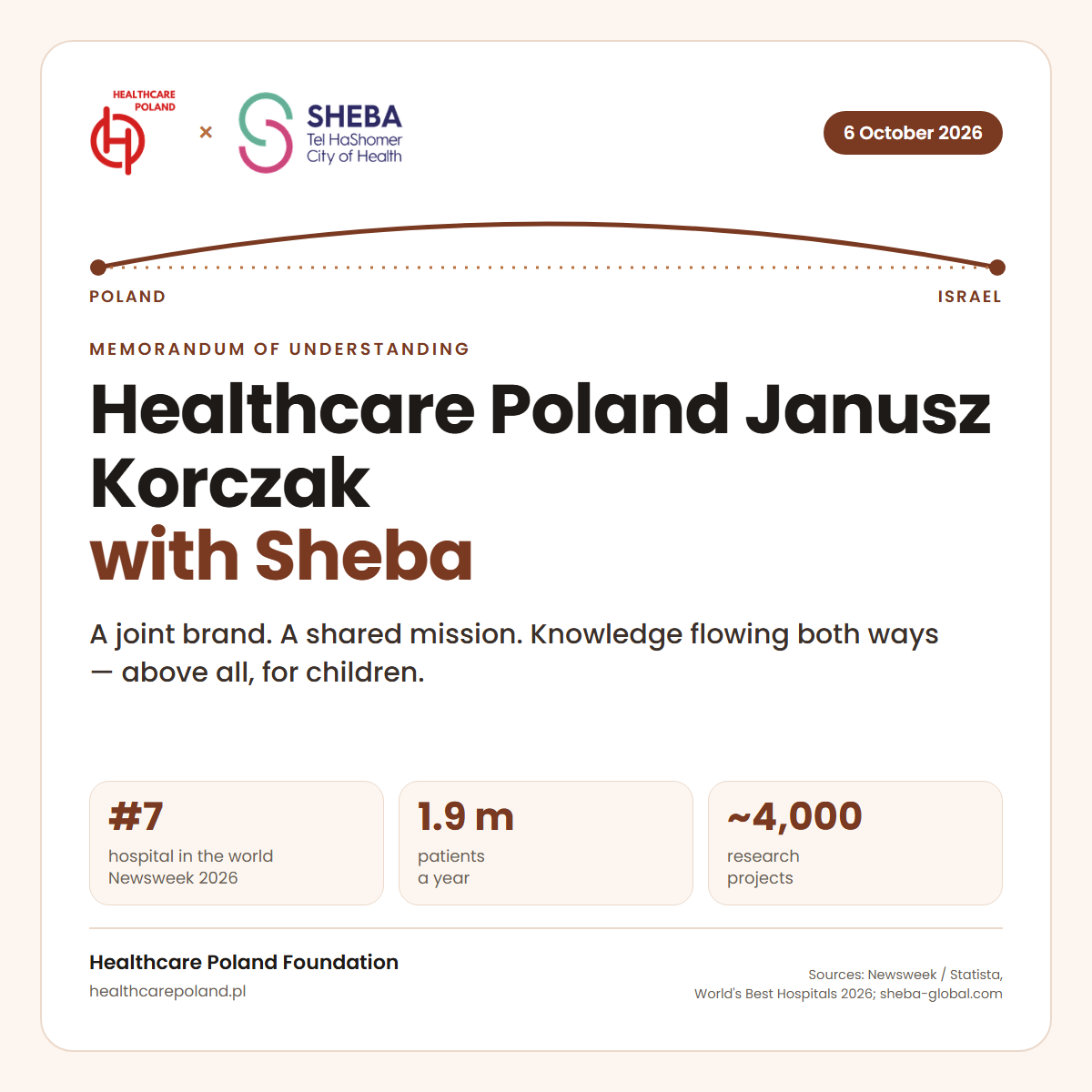
On 6 October 2026, the Healthcare Poland Foundation and The Sheba Fund sign a memorandum of understanding on cooperation carried out under the name Healthcare Poland Janusz Korczak with Sheba. On the Israeli side it is signed by Moshe Barak, CEO of The Sheba Fund, and Nadav Ben Yossef, Vice President for Global Affairs at Sheba Medical Center.

Sheba is the largest and most comprehensive medical centre in the Middle East. In the “World’s Best Hospitals 2026” ranking by Newsweek and Statista it placed seventh in the world — the highest position ever achieved by an Israeli hospital — and it has been in the global top ten for eight years. These numbers are not decoration. They mark the level with which, from today, we can speak directly.
Newsweek 2026
every year
projects
continuously since 2013
Sources: Newsweek / Statista, “World’s Best Hospitals 2026”; Sheba Medical Center, “About Sheba” (as of September 2026).
Not a ward, but responsibility
The easiest thing would be to announce that Poland now has its own ward in one of the best hospitals in the world. It would be catchy — and untrue. The memorandum says it plainly: the cooperation does not create a ward, an organisational unit or a dedicated space in the hospital. Clinical responsibility rests entirely with Sheba and is governed by Israeli law. Healthcare Poland is responsible for the name — for creating it, protecting it and defending it.
I do not see this as a limitation. A patient who travels abroad for treatment needs clarity above all: who decides about their treatment, who is accountable for that decision, and where they can assert their rights. Just Culture, on which I base my work in healthcare, starts exactly here — responsibility is assigned before it is needed, not after the event. Trust can be built on that kind of clarity, and in cross-border medicine trust is a harder currency than any ranking.
Why Janusz Korczak
Henryk Goldszmit — Janusz Korczak — was a Polish Jew, a paediatrician, educator and writer. For three decades he ran the Orphans’ Home in Warsaw. In August 1942 he refused to save himself and, together with Stefania Wilczyńska, the staff of the home and some two hundred children, walked to the Umschlagplatz, from where they were deported to Treblinka. None of them survived.
His memory belongs to Poland and to Israel at the same time — and that is precisely why, in the legal sense, it is no one’s property. The memorandum says so explicitly. It is the brand “Healthcare Poland Janusz Korczak” that has an owner, and that owner is a Polish foundation.
Korczak was, above all, a doctor of children. He left a standard we would now call patient agency: a child — and every person who depends on the care of others — is not an object of concern but a person with their own dignity, voice and rights. That idea entered international law. In 1978 it was Poland that proposed drafting the Convention on the Rights of the Child at the United Nations, the work was led by the Polish lawyer Adam Łopatka, and the Convention adopted in 1989 is today recognised as part of Korczak’s legacy.
That is why paediatrics and neonatology are not just one of many areas in this cooperation. They are its heart. If, under Korczak’s name, we do not do more for sick children and their parents, the patron’s name will stop honouring us and start holding us to account.
An exchange, not a purchase
The most important thing about this agreement is that it does not describe a buyer and a seller. It describes a partnership in which both sides have something to learn from each other. The memorandum covers the transfer of clinical knowledge, professional training and joint expert work, and the parties may convene a regular scientific forum — alternating between Warsaw and Tel Aviv. Each of these areas will require a separate, detailed agreement. The memorandum opens the door. We have to walk through it ourselves.

Paediatrics and neonatology
Sheba’s campus is home to the Edmond and Lily Safra Children’s Hospital, the Josef Buchmann Gynecology and Maternity Center and a newborn screening centre. We want to understand how care for a newborn and for a chronically ill child becomes one continuous path — from diagnosis to rehabilitation and home.
Polish neonatologists and paediatricians, large and diverse patient populations, and a network of hospitals where new solutions can be implemented and rigorously measured. And Korczak’s legacy — Poland’s contribution to the global culture of children’s rights.
Oncology, cardiology, neurology
The Jusidman Cancer Center, the Olga and Lev Leviev Heart Center, the multiple sclerosis centre of excellence and the molecular brain-tumour laboratory are places where Sheba combines treatment with research. For Polish teams this is a chance for joint tumour boards, case exchange and fellowships.
The experience of Polish centres that treat very large numbers of patients within a public system and know how to practise good medicine with limited resources. Every system needs that knowledge — including the best.
Clinical research and joint projects
Sheba runs around 4,000 active research projects. We want to learn how studies are designed with clinicians from day one, and how quickly their results reach patients.
An extensive network of Polish research sites and patients for whom taking part in a trial is sometimes the only route to a new therapy. On the Foundation’s side, the HCPL Clinical Trials Department is responsible for this — projects are meant to be built together, not commissioned.
Protocols and a culture of quality
Not just individual procedures, but how a protocol is created, implemented, measured and improved. Sheba has held the JCI Gold Seal since 2013 and is developing the measurement of patient-reported outcomes (PROMs).
Polish hospitals that are already on the path of accreditation and quality measurement, and the network of the Polish Hospital Federation, in which good practice spreads faster than regulation.
System resilience
Sheba develops hospital emergency preparedness, runs a humanitarian and disaster response centre and an institute for pandemic preparedness research.
Recent experience: since 2022 the Polish health system has received and transferred patients from Ukraine, and our hospitals are learning to operate under new threats. Joint resilience projects can strengthen both systems.
Staff training — including trauma and stress
Simulation training, Sheba’s academy programmes and experience of working under prolonged psychological strain. Coping with trauma and stress decides whether staff stay in the profession — and whether the patient meets a person rather than a tired system.
HCPL Academy programmes, young doctors, nurses and paramedics ready to learn and to teach others — and the will to co-create standards, not just import them.
The chance for a leap in quality does not lie in some Polish hospital appearing on Newsweek’s list tomorrow. It lies in the benchmark ceasing to be an abstraction. When Polish doctors can see how the world’s seventh-best hospital works — and show it how we work — the distance is no longer insurmountable. An exchange is real only when both sides come back wiser.
What Poland gains
Openness is not an add-on here. Poland has no dedicated law on medical tourism, so the general rules apply — freedom of economic activity, protection of competition and the transparency expected of non-governmental organisations. A foundation acting in the public interest does not close the market for a single entity. From the patient’s perspective, the greatest risk in medical tourism is capture of access by an intermediary who controls the channel and hides the costs. This architecture is designed not to allow it.

What this cooperation opens in practice
The memorandum is a framework. Its substance is the programmes already running on both sides and the patient pathway the Foundation runs on the Polish side.
Sheba’s programmes
On the Healthcare Poland side: departments for cooperation
We enter this cooperation where we see gaps in the Polish system. Each of these areas has its own department or programme within the Foundation, and a person responsible for it.
The patient pathway from Poland and Europe
The entry point is the treating physician, not an advertisement. The same pathway is open to patients from other European countries:
- The treating physician submits a specific clinical question.
- The Foundation checks that the documentation is complete and indicates a secure channel for transferring data.
- Consultation at Sheba. The opinion belongs to the centre, and on the Israeli side the patient is handled by entities authorised under Israeli law.
- The patient learns the cost and timeline before the decision, not after it. We do not promise reimbursement or funding.
- Treatment at Sheba. Clinical responsibility rests solely with Sheba.
- Return to the treating physician with complete documentation. Continuity of care at home is a condition, not an extra.
Operational details on Sheba’s side — service standards, data protection and settlements — will be agreed by the parties in an operational agreement.
The first model of its kind in the world — what it means and what it does not
Sheba has been building a network of international partnerships for years. Before writing about being first, we analysed the publicly announced agreements of Sheba Medical Center and Sheba Global. Four models of cooperation emerge from them.
- Sister institutions and knowledge exchange. MD Anderson Cancer Center (oncology), Mayo Clinic (technology implementation), Hospital Israelita Albert Einstein in Brazil (data, precision medicine). Each party keeps its own brand.
- Transformation partnership. University Hospital Center “Mother Teresa” in Tirana, since January 2025. A five-year rebuilding of oncology services, training and technology transfer — with no joint name.
- Agreement with a health system. PureHealth in the United Arab Emirates, June 2023. It covers clinical research, genetics, training and medical tourism — with no joint brand.
- The ARC innovation network. Including the Charité BIH ARC Innovation Center in Berlin, opened on 2 June 2026. The centres adopt the ARC model but operate as independent institutions under their own names. They do not treat patients.
Against this background, Healthcare Poland Janusz Korczak with Sheba combines four elements that we have not found together in any of Sheba’s publicly available agreements:
- a joint name in which the partner’s brand stands next to Sheba’s;
- a patron — a figure who belongs to the memory of two nations, not a trade name;
- ownership of the brand by a partner from outside Israel, a Polish foundation;
- an orderly patient access pathway that begins with the treating physician and gives no one exclusivity.
That is why we write: to the best of our knowledge and on the basis of publicly available information, this is the world’s first model of cooperation with Sheba that combines a joint brand bearing the name of a patron with ownership of that brand by a foreign partner. We say this with caution, because not all international hospital agreements are made public. If anyone points to an earlier case, we will gladly describe it. In medicine, what counts is the standard, not the laurels of being first.
Being first is not a trophy here, but a burden of proof. A model created for the first time has nothing to refer to. Each of its mistakes would become an argument against those who want to follow this path after us. Just Culture requires responsibility to be assigned in advance. Here we assign it also towards our successors: other countries and other institutions that will build a similar bridge with the world’s leading centres. That is why we set down the rules so that they can be repeated: transparent criteria, no exclusivity, clinical responsibility on Sheba’s side and continuity of care at home. A first model makes sense only if it becomes a standard.
What we do next in Poland
The memorandum opens the door, but we will measure its value by what changes in Polish hospitals and clinics. That is why we organise Healthcare Poland’s work at home along six lines.

- A network of physician-integrators. Our most important task is to build a network of physicians able to bring solutions from the world’s top ten hospitals into their own centres in Poland. This is not about one-off placements, but about people who come back with a ready protocol and know how to implement it, measure it and defend it before their team. An innovation that no one can integrate into daily practice remains a curiosity.
- Guaranteed international certification and career paths. We guarantee that taking part in exchange programmes ends with an internationally recognised certificate and has a real effect on professional development. A physician, nurse or manager who invests time in learning from the best gains a lasting, recognisable record of achievement — not just good memories.
- A faster route for innovation. We will support faster assessment and implementation of innovation in the Polish system, including through regulatory sandboxes — an area I help shape as Leader of the Regulatory Sandboxes and Innovation Support Section of GRAI at the Ministry of Digital Affairs — and through rigorous preparation of evidence for health technology assessment. The time between an effective solution and the patient is a measure of a system’s efficiency, and every unnecessary month has a clinical cost.
- A funding channel for treatment outside Poland and Europe. For technologies and protocols not yet available in Poland, we are building an orderly channel for funding treatment abroad, including outside the European Union. It is meant to operate until a given solution has been integrated into Polish practice. Where the law allows, we will seek the participation of the National Health Fund (NFZ). This is work on the system, not a promise of funding for an individual patient.
- Quality measured by outcomes. We want to bring to Poland knowledge of how Israel measures the quality of care. Since 2004 it has run a national programme of quality indicators in community healthcare (QICH), covering 69 indicators and the entire insured population across all four health funds, with results made public. Sheba, together with ICHOM, is developing a value-based approach (Value-Based Healthcare) that assesses the outcome of treatment from the patient’s perspective rather than the number of procedures performed. For the Polish system, which still pays mainly for procedures, this knowledge is of strategic importance.
- Quality to the JCI standard. Sheba has held Joint Commission International accreditation continuously since 2013. The same standard is now available to Polish hospitals through Healthcare Poland. The Foundation is the exclusive JCI-authorised and JCI-trained provider of JCI Services in the Republic of Poland, under a Collaborative Agreement with Joint Commission Resources, Inc. Hospitals interested in cooperation can prepare for the standard with us — in full or in selected elements. Accreditation is granted solely by JCI; the Foundation is independent of JCI, and the conclusion of the agreement does not constitute an endorsement of its services by JCI. More: “The currency of trust. What a Polish hospital gains on the JCI and TQAMS pathway”.
Each of these lines requires separate agreements and its own timetable. They share one criterion: the benefit must arise in Poland and for the patient treated in Poland.
How it began
It all started with one phone call. The Embassy of Israel in Warsaw introduced us to the Polish EMAS Foundation, operating under the EMASMED brand. Almost a year ago we signed a cooperation agreement with it — and since that day its team has been with us at every stage of this journey. Thanks to that support we can say with pride today that, to our knowledge, we are the first Polish institution to co-create its own brand with the world’s seventh-best hospital.
Until now, access to medicine at this level belonged mostly to those who could buy it. We did not come to shop. We came for a partnership — and that is what I am proudest of.

Where we spoke about this before
This journey did not begin today, and we described it as it unfolded. In the recording from Israel I spoke about this project as a ward — that is what we called it on the Polish side before we sat down with Sheba’s lawyers. Those talks led to a form that is more honest towards the patient: a joint brand rather than a unit in the hospital. The recording shows where we started.
- YouTube · Michał P. Dybowski · in Polish“The truth behind the plan for a Janusz Korczak Ward in Israel — Sheba (City of Health)” — recorded in Israel, from 15:11.
- healthcarepoland.pl · 8 September 2026“An orderly patient route. What Healthcare Poland is doing in Israel for patients from Poland”
- healthcarepoland.pl · 30 April 2026“President of Healthcare Poland Foundation in Tel Aviv. Working visit at Assuta Medical Centers”
- healthcarepoland.plMedical Tourism — MEDiTOUR — how the Foundation works in cross-border medicine.
- LinkedInOngoing posts on the cooperation with Israel: Michał P. Dybowski’s profile and the Healthcare Poland page.
Thank you
- Elena Malt · President, EMAS Foundation (EMASMED)
above all — for persistence, patience and presence at every stage. And Marek Szczukowski · Director, EMAS Foundation — for taking care of everything that happened between the meetings. - Paz Gantovski · Director, Global Medical Initiatives, Sheba Medical Center
for seeing the project through on Sheba’s side. - His Excellency Yaakov Finkelstein · Ambassador of Israel to Poland
and the whole team of the Embassy of Israel in Warsaw, in particular the Economic Department — for the immense work put into this agreement. - The Embassy of the Republic of Poland in Tel Aviv
Ambassador Maciej Hunia, who, despite his duties in Jerusalem, decided to delegate a representative of the embassy, and Ms Anna Godoj-Ciszkowska · Head of the Political and Economic Section — your presence is an additional honour for us. - This success also rests on the trust of public institutions. I thank Deputy Minister of Health Katarzyna Kacperczyk for her recommendation and the mandate of trust for our work in medical tourism, Bartłomiej Chmielowiec, Patient Ombudsman, Katarzyna Drążek-Laskowska, Director of the International Cooperation Department, Ministry of Health, and Michał Chrobot of the Ministry of Health — for the contribution and trust that gave us the mandate for this conversation.
- Prof. Jarosław J. Fedorowski · Chair of the Council of the Healthcare Poland Foundation, President of the Polish Hospital Federation
for the vision he planted in the Foundation’s Council more than three years ago. Today it has come true. - Ewelina Bogiel, CAMS · Head of Law & Compliance, Healthcare Poland Foundation
for the legal support without which we would not have made it through successive versions of the agreement.
Thank you all. Thanks to you, Poland gains in standing and Healthcare Poland has its place in Israel — for many years, I hope. You can meet the people building this cooperation on the Foundation’s side at healthcarepoland.pl and on the Healthcare Poland LinkedIn page.
Finally, something personal. So that no one can say we are building a showcase solution, I am walking this path myself. Not as a paediatric patient, but as an oncology patient — someone for whom the Polish system lacked a systemic understanding of his situation. I am walking it to see how this system really works for Poles, what it offers them, and what experience we can bring back to Poland.
I do not write this with regret. I write it because this is how I understand responsibility for a brand that bears a doctor’s name: first test on yourself what you propose to others.
Korczak did not leave us instructions. He left us a measure: does the person who depends on our care feel treated as a person, and not as a task? That is the measure we are signing up to.
Sources
- Newsweek / Statista, World’s Best Hospitals 2026; JNS.
- Sheba Medical Center, About Sheba — number of physicians, patients, research projects, JCI accreditation, clinical centres.
- United States Holocaust Memorial Museum, Janusz Korczak; Museum of Warsaw, Korczakianum.
- UN SRSG on Violence against Children, Poland and the Convention on the Rights of the Child.
- Sheba Global, “Global Medical Initiatives Division” — partnerships with MD Anderson, Mayo Clinic, Hospital Israelita Albert Einstein and QSUNT “Mother Teresa”: sheba-global.com.
- Council of Ministers of the Republic of Albania, 24 January 2025 — strategic partnership between QSUNT “Mother Teresa” and Sheba Medical Center: kryeministria.al.
- Gulf Business, 16 June 2023 — PureHealth and Sheba Medical Center memorandum: gulfbusiness.com.
- BIH at Charité, 2 June 2026 — opening of the Charité BIH ARC Innovation Center: bihealth.org.
- Israel National Institute for Health Policy Research — The National Program for Quality Indicators in Community Healthcare (QICH): israelhpr.org.il.
- ICHOM, 13 November 2024 — Sheba Medical Center’s global breast cancer care initiative: ichom.org.