Three years of mandate, twenty-seven areas of activity, one measure: does what we do fulfil the goals we wrote into our Statute.
SummaryThree years of mandate
27 October 2026 marks three years since the Healthcare Poland Foundation was entered into the Polish National Court Register (KRS). The review of this period shows that the Foundation pursues all three goals of its Statute, with a clear predominance of the third — quality of healthcare and value for the patient.
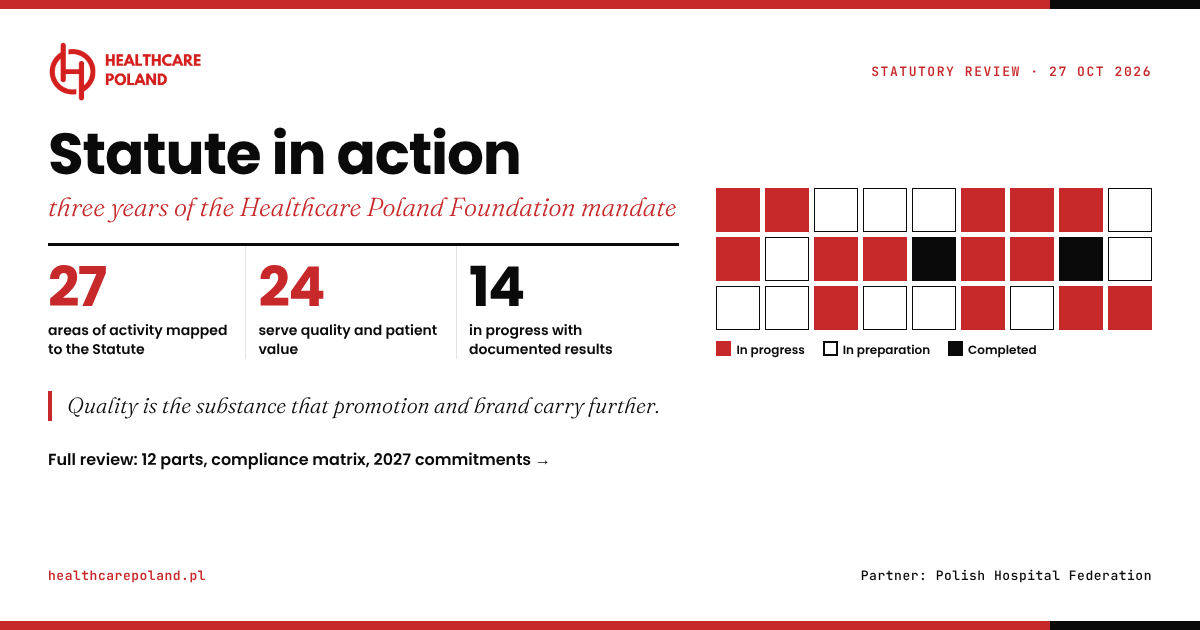
The analysis covers 27 areas of activity derived from the Foundation’s project register and mapped to the goals (§ 4) and means (§ 5) of the Statute. The quality goal (C3) appears in 24 of them, international promotion (C1) in 7, and brand building with a Three Seas priority (C2) in 4. Fourteen areas are in progress with documented results, eleven remain in preparation, and two closed undertakings have been completed in full.
The most important documented facts include:
- the HeliX grant agreement of 29 July 2025, in which the Foundation is the only partner from Poland and leads the regulatory compliance task;
- the CyberC4HE Coalition, operating on the Foundation’s initiative since 29 May 2024;
- the address of the Foundation’s President at the European Parliament (17 March 2026) on cross-border care;
- the “Healthcare Poland Janusz Korczak with Sheba” agreement, signed on 6 October 2026 at Sheba Medical Center (Tel HaShomer);
- the founding act of the Union of Coordinated Care Employers (ZPOK) of 24 September 2026, initiated by the Foundation;
- the decision to establish the Centre for Mediation, Conciliation and Arbitration of 3 October 2026;
- the launch of services preparing Polish facilities for international accreditation (September 2026).
The thesis of this article is twofold. The broad scope of the Foundation’s activities — from cybersecurity to clinical trials — is not a departure from the Statute but a consistent interpretation of “broadly understood quality”. At the same time, making full use of the mandate requires growth where the Statute is most specific: in the Three Seas dimension and medical tourism (§ 4), and in instruments the Foundation has not yet used, such as a scholarship programme and its own publication series (§ 5). Naming these areas is part of honest reporting, not a finding of non-compliance with the Statute.
Part IThe statutory mandate: three goals, ten means, one responsibility
The Statute of the Healthcare Poland Foundation, in force since 22 August 2023, sets three goals (§ 4) and ten means of pursuing them (§ 5). Every project of the Foundation is assessed against this norm, not against the intentions of its authors.
The Foundation was established by notarial deed of 22 August 2023 by Michał P. Dybowski and Jarosław J. Fedorowski. Its legal basis is the Polish Act on Foundations of 6 April 1984, the Act on Public Benefit Activity and Volunteering of 24 April 2003 and the Act on Medical Activity of 15 April 2011. The Foundation was entered into the National Court Register on 27 October 2023 under number 0001066269, is seated in Warsaw and — under § 3(2) of the Statute — is supervised by the competent minister.
Three goals: substance and its projection
| Code | Wording of the goal (§ 4 of the Statute) | Function in the architecture of the mandate |
|---|---|---|
| C1 | promotion of Polish healthcare and Polish medicine internationally | visibility: taking Polish achievements abroad |
| C2 | building and strengthening the international brand of Polish healthcare and medicine, with particular regard to the Three Seas Initiative area | trust: lasting reputation, with a regional priority |
| C3 | supporting broadly understood quality in healthcare and the development of value-based care for the patient, including in medical tourism | substance: quality and value that can be demonstrated |
The goals are not parallel declarations but a chain. C3 provides the substance; C1 and C2 give it reach and durability. A brand without quality would be a promise without cover; quality without promotion would remain invisible to partners, patients and investors.
The phrase “broadly understood quality” is the interpretive key to the whole mandate. Contemporary health systems science does not reduce quality to clinical effectiveness: it also covers safety, people-centredness, timeliness, equity, integration and efficiency of care (WHO, OECD and World Bank, 2018). The formula of “value-based care for the patient” refers to the value-based healthcare paradigm, in which the measure is the health outcome achieved relative to the resources used (M. E. Porter, 2010).
This interpretation encompasses digital security and crisis resilience of the hospital, workforce competence, access to therapy, quality of management and out-of-court resolution of medical disputes. It is not an expansive interpretation; it reads the norm in line with current knowledge, in which quality is a property of the whole system rather than of a single procedure.
Ten means and the support clause
| Code | Means of pursuing the goals (§ 5 of the Statute, abridged) |
|---|---|
| Ś1 | raising resources from natural and legal persons in Poland and abroad |
| Ś2 | organising, attending and funding national and international conferences, seminars and scientific-medical workshops, and congresses of medical societies in the field of telemedicine |
| Ś3 | cooperation and coordination with non-governmental organisations and the public and private sectors |
| Ś4 | a scholarship programme for medical students |
| Ś5 | implementing, participating in and funding promotional, informational, scientific, educational or research projects |
| Ś6 | information campaigns in the mass media and the digital domain |
| Ś7 | scientific programmes providing information relevant to the Foundation’s goal |
| Ś8 | running and participating in publishing activity |
| Ś9 | cooperation with state and local government authorities, institutions, enterprises, NGOs and individuals in Poland and abroad |
| Ś10 | international cooperation |
They are complemented by § 6: the Foundation may support the activity of other persons and institutions consistent with its goals. This is the basis for partnerships in which the Foundation is not the contractor but the catalyst.
Constitutional instruments
The Statute also provides organisational tools without which a broad programme would not be feasible:
- § 2(2) — activity outside Poland “to the extent necessary for the proper pursuit of the goals”;
- § 2(3) — the right to establish subordinate units;
- § 2(4) — membership in domestic and foreign organisations, associations, clusters and foundations;
- § 3(3) — establishing badges and honorary titles and granting awards;
- § 13 — business activity serving exclusively statutory goals, including consulting, research and development, education, publishing and congress activity, IT services and medical practice.
The order of responsibility
The Management Board “is accountable to the Founder for the pursuit of the Foundation’s statutory goals and for the correctness and purposefulness (rationality) of the Foundation’s actions” and prepares annual reports (§ 16). The Foundation Council — a body of substantive support (§ 18) — gives opinions, at the Board’s request, on research projects, publications and educational programmes, and represents the Foundation scientifically in public (§ 19).
Integrity safeguards are contained in §§ 10 and 11 of the Statute, which exclude preferential treatment of members of governing bodies, employees and persons close to them. Finally, § 23(1) provides for the liquidation of the Foundation once its goals are achieved or become obsolete. The statutory goals are thus the measure of the Foundation’s raison d’être.
Part IIMethod: how we test a project’s compliance with the Statute
We assess compliance with a three-step test: purpose, instrument and evidence. A project fulfils the mandate only when it passes all three.
- Purpose test — does the project serve one of the § 4 goals: promotion (C1), brand with a Three Seas priority (C2) or quality and patient value (C3)?
- Instrument test — does it use a § 5 means (Ś1–Ś10) or a constitutional instrument from § 2, § 6 or § 13?
- Evidence test — is there a dated fact: a signed agreement, a held event, a published work, an adopted decision? Without it we are dealing with intent, not delivery.
The status scale has three levels: completed (closed result), in progress (documented partial results, work continuing) and in preparation (concept, offer, talks). We also distinguish capability from delivery. A standard, an offer or an established unit is a capability; a service delivered to a facility is delivery. A technical artefact produced in a project, such as a demonstrator, also counts as a partial result.
The factual basis is the Foundation’s documentation as of 27 October 2026: the project register (59 items), the knowledge map, value stream charters approved on 19 October 2026, the register of Board resolutions and project documentation. Registry data were checked against public sources. From the 59 items, 27 areas were derived: thematically identical projects were merged, while initiatives of other entities and roles held personally by members of governing bodies were excluded.
- where sources diverge, we adopt the newer and more conservative version;
- automatic meeting summaries are treated as leads, not evidence;
- undertakings of cooperating entities, including the Polish Hospital Federation, are included only where the Foundation is a formal participant, and its role is stated;
- figures come from registers and documents, not declarations;
- undertakings whose public description requires a partner’s consent are presented without naming the partner or omitted until consent is obtained.
Part IIIChronology: from the founding deed to the third anniversary of registration
The Foundation’s path falls into four stages: establishment (2023), first initiatives (2024), entry into European projects and partnerships (2025) and institutionalisation (2026). The densest year is 2026, when the departmental structure was created and twelve value streams were approved.
The table covers events confirmed by documents. The last column indicates the goal or means of the Statute the event serves.
| Date | Event | Goal · means |
|---|---|---|
| 22.08.2023 | Notarial deed establishing the Foundation and its Statute | basis |
| 27.10.2023 | Entry into the National Court Register (KRS 0001066269) | basis |
| 28.11.2023 | First supporting partner of the Foundation | Ś3 |
| 29.05.2024 | CyberC4HE Coalition established on the Foundation’s initiative, with the Polish Hospital Federation | C3 · Ś3 |
| IX–X 2024 | NIS2 training for hospitals in Białystok and Szczecin | C3 · Ś5 |
| 28.11.2024 | Response of the Ministry of Health’s e-Health Department to the Foundation’s recommendations on cybersecurity in the National Recovery Plan | C3 · Ś9 |
| XI–XII 2024 | GreenBook — ESG reporting handbook for hospitals, published by the Polish Hospital Federation with the Foundation’s substantive input (launch 02.12.2024) | C3 · Ś8 |
| 05.12.2024 | HeliX proposal submitted under the Interregional Innovation Investments (I3) instrument | C1 · Ś5 |
| I 2025 | “Innovation in healthcare” working group with the Pomeranian Marshal’s Office | C3 · Ś9 |
| 10.01.2025 | Letters of intent HCPL–LAW and PFSz–LAW with the Polish Air Force University in Dęblin | C3 · Ś9 |
| 29.05.2025 | 1st Gorzów Hospital Security Forum (HCPL, PFSz, Gorzów hospital) | C3 · Ś3 |
| 29.07.2025 | HeliX grant agreement no. 101228287; implementation 15.09.2025–14.09.2028 | C1 · C3 · Ś10 |
| 04.09.2025 | MedTech Innovation Day at the Economic Forum in Karpacz; results announced 01.10.2025 | C1 · C3 · Ś2 |
| 27.10.2025 | HeliX consortium kick-off in Porto | C1 · Ś10 |
| XI 2025 | Report “Hospital Security and Protection (2025–2030)” (HCPL, PFSz) | C3 · Ś7 · Ś8 |
| 2025 | First quality audit using the TQAMS methodology (rehabilitation hospital) | C3 · Ś5 |
| 17.03.2026 | Address of the Foundation’s President at the 8th European HTI Summit, European Parliament | C1 · Ś2 · Ś10 |
| 20.03.2026 | Startup Innovation Day in Kraków with the Foundation’s participation | C1 · C3 · Ś2 |
| 13.04.2026 | NIS2/EHDS workshops for Pomeranian hospitals at the Marshal’s Office in Gdańsk | C3 · Ś3 · Ś9 |
| 27.04.2026 | 2nd Forum in Gorzów — digital resilience and EHDS | C3 · Ś3 |
| 28.04.2026 | Foundation position on access to an innovative therapy (Opole case) | C3 · Ś6 |
| 08.05.2026 | Establishment of the Clinical Trials Department | C3 · § 2(3) |
| 24.06.2026 | Position of the ZOL/ZPO Coalition (KiDO, PFSz, HCPL) on a draft Ministry of Health regulation | C3 · Ś9 |
| 14.07.2026 | Medical tourism area transformed into the Cross-Border Medicine Department | C1 · C3 |
| 21.09.2026 | “Twelve value streams” newsletter; launch of international accreditation readiness services | C2 · C3 · Ś6 |
| 24.09.2026 | Founding act of the Union of Coordinated Care Employers on the Foundation’s initiative | C3 · Ś3 |
| 03.10.2026 | Decision to establish the Centre for Mediation, Conciliation and Arbitration | C3 · § 2(3) |
| 06.10.2026 | “Healthcare Poland Janusz Korczak with Sheba” agreement signed at Sheba Medical Center | C1 · C3 · Ś10 |
| 07.10.2026 | Withdrawal from the Global Healthcare Systems Hub (GHSH) medical tourism project | governance |
| 17–18.10.2026 | Six HCPL Academy courses published in e-learning | C3 · Ś5 |
| 19.10.2026 | Approval of twelve value streams and the self-learning loop | governance |
| 22.10.2026 | ZOL/ZPO Coalition webinar on technologies in long-term care | C3 · Ś2 |
| 23.10.2026 | Letter of support from CyberC4HE and PFSz for Pomerania’s application for a Local Cybersecurity Centre | C3 · Ś9 |
Part IVQuality of care and value for the patient
The third goal (C3) is the core of the Foundation’s activity: 24 of 27 areas serve it. This part concerns organisational quality, patient rights and continuity of care; technology, workforce and security are discussed in Parts V, VI and VIII.
Quality that can be verified: audit and the TQAMS standard
The Centre for Quality, Audit and Certification (CAC HCPL) turns “broadly understood quality” into a service: one audit instead of several parallel compliance tracks. Its first documented delivery was a 2025 quality audit in a rehabilitation hospital using the TQAMS methodology. Version 1.0 of the TQAMS standard was completed in March 2026 and updated in August 2026; formal approval will follow a pilot in several facilities. Statutorily this is primarily C3, pursued through Ś3 and Ś5; the C2 dimension lies in a verifiable quality standard becoming a carrier of the international brand of Polish healthcare.
Preparing for international accreditation
The second pillar is preparing facilities for international accreditation. Since September 2026 the Foundation has offered gap analysis against accreditation requirements and mock accreditation surveys, so a facility does not need to build its own preparation team. In October 2026 the Foundation concluded an international agreement defining its role in preparing member hospitals of the Polish Hospital Federation for Joint Commission International accreditation. The Foundation prepares facilities but does not accredit them: accreditation decisions rest solely with the accrediting body. Statutorily this is C3 and C2 — an international standard becomes part of Poland’s brand of trust — pursued through Ś5 and Ś10.
Out-of-court dispute resolution: the Centre for Mediation, Conciliation and Arbitration
On 3 October 2026 the Board decided to establish the Centre for Mediation, Conciliation and Arbitration, with a Court of Arbitration, within the Legal & Compliance Department. The Centre is meant to close disputes other than by judgment or silence, and to preserve an adverse event as learning material, in line with the principles of Just Culture. Its constitutional basis is § 2(3) of the Statute. Until its rules and list of arbitrators are adopted (Q4 2026), the Foundation does not conclude agreements containing the Centre’s clause.
The patient facing an unavailable therapy
The Foundation has mapped the lawful pathways of access to therapies unavailable in routine treatment — from targeted import, through therapeutic experiment, to cross-border care. On 28 April 2026 it took a public position on access to an innovative therapy in the Opole case. This is a direct pursuit of “value for the patient” (C3) through information activity (Ś5, Ś6) and dialogue with the authorities (Ś9).
Continuity of care: ZPOK, ZOL/ZPO, Longevity 360
On 24 September 2026 the founding act of the Union of Coordinated Care Employers (ZPOK) was signed. The Foundation is the initiator, together with the Polish Hospital Federation, the National Chamber of Care Homes (KiDO) and other sector organisations. The Union is to represent coordinated-care employers — who previously had no separate representation — before the Ministry of Health and the National Health Fund; the next step is its registration.
In parallel the Foundation acts as secretariat of the coalition for long-term care facilities (ZOL/ZPO), formed with KiDO and PFSz. The coalition addressed an appeal to the Minister of Health (May 2026) and a position on a draft regulation (24.06.2026), and on 22 October 2026 co-organised a webinar on technologies in long-term care with foreign providers.
The Longevity 360 centre has a ready programme architecture for healthcare employers; the pilot awaits its first partners, so the area remains in preparation.
Accessibility as a measure of quality
The Foundation is a signatory of the Partnership for Accessibility under the Accessibility Plus programme of the Ministry of Funds and Regional Policy. The component is led by a Foundation Council member for accessibility, and the HCPL Academy offers an “Accessibility” course. Accessibility is a condition of quality, not an add-on.
Part VInnovation, data and research
In this domain the Foundation has primarily built capability: standards, models and structures meant to improve the quality of technology decisions in hospitals (C3). The work of the Clinical Trials Department and the open information system is the most advanced; the Living Lab remains in preparation.
Clinical Trials Department
Established on 8 May 2026 and headed by pharmacist Klaudiusz Gajewski, the Department systematically monitors clinical trials in the EU CTIS system. The first monitored area is sarcoma: in June 2026 the overview covered 111 trials, of which 59 were recruiting, and only 14 (approx. 13%) had a site in Poland. The finding concerns one group of cancers and should not be generalised, but it shows the scale of the task.
Since September 2026 the Department has been preparing a standard agreement for research sites and a virtual trial-support centre. It does not recruit patients or give medical advice. Statutorily this is Ś5 and Ś7; the unit’s constitutional basis is § 2(3).
Open information system and data governance
The Open HCPL HIS project (OpenEMR integrated with Poland’s P1 platform) aims to give hospitals an open core information system and free them from single-vendor lock-in. A demonstrator on synthetic data exists, and on 15 October 2026 the principle was adopted that the system be designed from the outset with international quality and patient-safety requirements in mind. The Foundation has submitted the project to open-source support programmes (Sovereign Tech Fund, NLnet) and joined the consultation on HIS interfaces run by Poland’s e-Health Centre.
The Data Governance component organises five questions about data — which data, whose, who has access, in what quality and by which route they flow — into one compliance system instead of three (GDPR, NIS2, EHDS). It is complemented by the AI Vendor Standard in Healthcare (SDAI) version 0.9, adopted on 10 August 2026 as a consultation draft. SDAI certification is to cover the AI vendor and its processes rather than a single product. Both initiatives are in preparation; their measure will be the first assessments carried out for facilities and vendors.
Living Lab and operational sandbox
The Innovation Centre (CI HCPL) has developed a model for testing solutions in a clinical environment with four modes (own, scientific, regulatory and commercial) and a seven-stage validation process. Since May 2026 talks have been under way with a national supercomputing centre on infrastructure, but agreements with host facilities have not yet been concluded. The area therefore remains a capability, not delivery.
Innovation competitions
The Foundation co-organised MedTech Innovation Day at the Economic Forum in Karpacz (4 September 2025): a jury convened with its participation selected the winners — BRASTER, BioCam and EndoFind. Startup Innovation Day in Kraków (20 March 2026), moderated by Prof. Piotr J. Senkus, attracted 18 entries; BioNwoven won. This is C1 and C3 through Ś2, Ś3 and Ś6: Polish innovation gains a stage, and hospitals an overview of mature solutions.
Part VIKnowledge, workforce and the public voice
Workforce competence and the quality of public debate are conditions of quality of care (C3). The Foundation develops them through the HCPL Academy, work on sector competences, patronages, publications and advocacy towards public authorities.
HCPL Academy and Global Life Frontier Academy
The Academy’s catalogue comprises 53 programmes aligned with the Polish Qualifications Framework, built modularly: a facility can order a full pathway or a single module. On 17–18 October 2026 six courses were published in e-learning, including the 24-hour “Medical Tourism Coordinator” training, whose first edition is scheduled for 16–27 November 2026. The Academy has not yet completed an edition, so we assess it as in progress.
Global Life Frontier Academy (GLFA), operating within the Medical Care Department, is to support Polish physicians in obtaining international certifications and building career pathways. It bridges quality (C3) and the international presence of Polish medicine (C1); the offer remains in preparation.
Sector competences
The Foundation’s President sits on the Sector Skills Council run by the Polish Hospital Federation in a project of the Polish Agency for Enterprise Development (PARP). On 26 June 2026 the Council adopted his proposal to include competences in serving foreign-language patients, arising from the cross-border healthcare directive, in the care-coordinator profile. Promotion (C1) and quality (C3) meet here in a single competence standard.
Patronages and distinctions
The Foundation grants honorary patronage to undertakings consistent with its goals: the “Young Think Policy Briefs” conference (16 July 2026) and the “SOZ Instruments” conference (patronage of 9 October 2026). Members of the MedTech Innovation Day jury received diplomas from the Foundation. The instrument of badges and honorary titles under § 3(3) of the Statute has not yet been launched.
Publications
The Foundation participates in publishing as co-author of expert publications; it does not yet run its own publishing. The most important publications are:
- GreenBook — ESG reporting handbook for hospitals, published by the Polish Hospital Federation in November 2024 with the Foundation’s substantive input;
- the report “Hospital Security and Protection in the Hospital Ecosystem in Poland (2025–2030)”, prepared with PFSz in November 2025 and made available to a sector publisher in June 2026;
- the handbook for the “Medical Tourism Coordinator” course.
Public voice and advocacy
The Foundation communicates through the Healthcare Innovation newsletter, value stream pages in Polish and English, social media and the video podcast “AI dla Zdrowia” (AI for Health). Towards public authorities it speaks with expert argument. In November 2024 the Ministry of Health’s e-Health Department responded to its recommendations on cybersecurity in the National Recovery Plan; in August 2026 the Foundation, together with the CyberC4HE Coalition, submitted a position to the Ministry of Digital Affairs in the ENISA consultation; in October 2026 it prepared an opinion on the parliamentary hospital-workforce package. This is Ś6 and Ś9 in action.
Part VIIPolish medicine in the world: promotion, brand and the Three Seas
The promotional (C1) and brand (C2) goals open the § 4 catalogue, and the Foundation’s very name abbreviates them. After three years, international promotion rests on a European project, presence in EU debate and a partnership with one of the world’s leading hospitals. The Three Seas dimension, however, remains a direction under construction.
HeliX: the Polish partner of a European data ecosystem
HeliX (Health Ecosystem for Learning and Innovation Across Sovereign Data Spaces) is a project of the Interregional Innovation Investments instrument, running from 15 September 2025 to 14 September 2028 under grant agreement no. 101228287 of 29 July 2025. The consortium brings together 14 beneficiaries from five countries coordinated by Health Cluster Portugal; the Foundation is the only partner from Poland.
Throughout the project the Foundation leads task T1.5 — regulatory compliance with GDPR, the AI Act and EHDS. It contributed to the data management plan and mapped nine Polish health data sources. A consortium general assembly in Warsaw is planned for month 18 of the project (February–March 2027). HeliX pursues both C1 and C3 and means Ś5, Ś7 and Ś10.
In the European debate
On 17 March 2026 the Foundation’s President spoke at the 8th European HTI Summit in the European Parliament in Brussels, presenting six problems of cross-border care from the perspective of the Polish system. Such presence brings a Polish voice to where European health policy is shaped (C1, Ś2, Ś10).
Healthcare Poland Janusz Korczak with Sheba
On 6 October 2026, at Sheba Medical Center (Tel HaShomer), the “Healthcare Poland Janusz Korczak with Sheba” agreement was signed. Its directions are knowledge transfer on quality indicators and value-based care (assessing treatment outcomes, not the number of procedures), a network of Polish physicians implementing solutions from the world’s leading hospitals, international certification and career pathways in cooperation with GLFA, and exchange of experience in hospital safety procedures. Janusz Korczak’s patronage is not decoration: it is a reminder that the measure of a system is the dignity of its most vulnerable patient. Statutorily this is C1 and C3, pursued through Ś3 and Ś10.
Cross-border medicine and medical tourism
The Statute explicitly names medical tourism in the third goal. On 14 July 2026 the Foundation transformed this area into the Cross-Border Medicine Department and adopted the principle that medical tourism is part of a broader cross-border medicine subordinated to quality. The MEDiTOUR stream has a catalogue of ten service modules on three levels, based on the TQAMS standard, and the Academy has prepared coordinator training. The first services for patients and facilities have not yet been documented, so the area remains in preparation.
Gateway to Europe
The HCPL EU Health Gateway project, launched on 5 October 2026, aims to make the Foundation an entry point to Europe for non-EU entities: in certification, pilots, technology transfer and EHDS. It covers ten non-EU markets. Channels are being built: profiles have been prepared in the Enterprise Europe Network and talks begun with export-support institutions. This is C1 and C2 in preparation; the basis for activity abroad is § 2(2) of the Statute.
Three Seas: a direction under construction
The Statute sets as a priority building the brand “with particular regard to the Three Seas Initiative area”, and the Initiative today comprises 13 states. The facts are more modest than the norm. The Foundation works with three Hungarian partners in the HeliX consortium, whose general assembly was held in Budapest in March 2026. In October 2026 it prepared a Living Lab concept for Hungarian partners and agreed to prepare a framework agreement with an institution supporting economic cooperation in Central Europe. The Healthcare 3 Seas Security Forum remains a concept.
The Foundation has not yet concluded a bilateral agreement with an institution from another Three Seas state or organised a regional forum. Fulfilling this priority is the most important statutory task for the next period.
Order of roles
The Foundation acts as secretariat of GHSH, a foundation in registration, which falls within the support clause of § 6 of the Statute. On 7 October 2026 the Board decided to withdraw the Foundation from the GHSH medical tourism project: the project remains with GHSH, while the Foundation develops cross-border medicine in its own department. Proportion in commitments is also a form of fidelity to the Statute.
Part VIIISecurity, resilience and hospital transformation
Security is the Foundation’s oldest and best-documented line of activity. A hospital that is not resilient to a cyberattack, power outage or crisis cannot deliver quality, which is why this area falls within the third goal, even though the Statute does not name it explicitly.
The CyberC4HE Coalition
The Coalition was founded on 29 May 2024 in Warsaw on the Foundation’s initiative, in cooperation with the Polish Hospital Federation. It offers hospitals a questionnaire of 130 risk areas based on NIS2 and ENISA guidelines, a mock inspection and an adjustment plan. Its calendar includes NIS2 training in Białystok and Szczecin (autumn 2024), two security forums in Gorzów Wielkopolski (29.05.2025 and 27.04.2026) and workshops for Pomeranian hospitals in Gdańsk (13.04.2026).
In August 2026 the Foundation and the Coalition submitted a position to the Ministry of Digital Affairs in the ENISA consultation, and on 23 October 2026 CyberC4HE and PFSz issued a letter of support for the Pomeranian Voivodeship’s application for a Local Cybersecurity Centre. The Coalition pursues C3 through Ś3, Ś6 and Ś9.
Pomerania: from workshops to regional cooperation
The workshops of 13 April 2026, organised by the Pomeranian Marshal’s Office with the Foundation and PFSz, produced concepts for a regional security operations centre (SOC) and a Shared Services Centre for hospitals. Talks on further cooperation in healthcare digitalisation are ongoing; their outcome will be communicated once agreed by the parties.
The hospital in crisis: report and security department
In November 2025 the Foundation and PFSz prepared the report “Hospital Security and Protection in the Hospital Ecosystem in Poland (2025–2030)”; a new edition is in preparation. The Security and Civil Defence Department, headed by Janusz Janiszewski, has prepared an offer for local governments matching their obligations under Poland’s civil protection and civil defence act. Backup satellite connectivity for hospitals is also being considered; this concept has not yet reached the agreement stage.
Dual-use: Polish Air Force University
On 10 January 2025 two letters of intent were signed with the Polish Air Force University (LAW) in Dęblin: by the Foundation and by PFSz. The division of roles is clear: the Foundation is the operational axis, the University the educational and laboratory axis, and PFSz coordinates pilots and deployments. A hospital’s resilience to hybrid threats is today a dimension of quality of care (C3); cooperation with a public university is to pursue Ś3, Ś7 and Ś9 and is now being operationalised.
Green hospitals
The Green Hospitals Transformation Centre (GHTC) combines more rational operation with reliable, proportionate ESG reporting. Its output is the GreenBook, published by PFSz in November 2024 with the Foundation’s substantive input and presented on 2 December 2024 at the 13th PFSz Autumn Programme Conference. The next edition is to draw on a 2026 survey of hospitals.
Transformation and consolidation
The Foundation has prepared an audit methodology preceding local-government decisions on hospital consolidation: seven layers of analysis, nine weeks of work and a mandatory “no merger” option. The auditor declares the absence of conflicts of interest and does not offer implementation. The service is described on the Foundation’s website and awaits its first commissions.
Part IXCompliance matrix: 27 areas against the goals and means of the Statute
The matrix sets each area against the § 4 goals, the § 5 means, the confirming fact and the status. The “Status” column can be updated, so the matrix can serve the Board as a standing reporting tool.
| Area | Goals | Means and basis | Confirming fact | Status |
|---|---|---|---|---|
| CyberC4HE Coalition | C3 | Ś1, Ś3, Ś6, Ś9 | founded 29.05.2024; Gorzów forums 2025 and 2026 | In progress |
| CAC HCPL and TQAMS standard | C3, C2 | Ś3, Ś5 | first TQAMS-based audit (2025) | In progress |
| International accreditation readiness | C3, C2 | Ś5, Ś10 | service available since 09.2026 | In preparation |
| Data Governance and SDAI | C3 | Ś5, Ś7 | SDAI v0.9 — consultation draft (10.08.2026) | In preparation |
| Centre for Mediation, Conciliation and Arbitration | C3 | Ś3, Ś5; § 2(3) | Board decision (03.10.2026) | In preparation |
| Access to innovative therapies | C3 | Ś5, Ś6, Ś9 | position in the Opole case (28.04.2026) | In progress |
| Coordinated care and ZPOK | C3 | Ś3, Ś6, Ś9; § 6 | ZPOK founding act (24.09.2026) | In progress |
| ZOL/ZPO Coalition | C3 | Ś2, Ś3, Ś9, Ś10 | position (24.06.2026); webinar (22.10.2026) | In progress |
| Longevity 360 | C3 | Ś5 | programme architecture (08.2026) | In preparation |
| Accessibility Plus | C3 | Ś3, Ś5, Ś9 | Partnership for Accessibility; “Accessibility” course | In progress |
| Innovation Centre and Living Lab | C3 | Ś3, Ś5 | four-mode testing model | In preparation |
| Open HCPL HIS | C3 | Ś1, Ś5, Ś7 | demonstrator; submissions to STF and NLnet (08–09.2026) | In progress |
| Clinical Trials Department | C3 | Ś5, Ś7; § 2(3) | monitoring of 111 trials in CTIS (06.2026) | In progress |
| MedTech and Startup Innovation Day | C1, C3 | Ś2, Ś3, Ś6 | Karpacz 04.09.2025; Kraków 20.03.2026 | Completed |
| HCPL Academy and GLFA | C3, C1 | Ś3, Ś5 | six e-learning courses (10.2026) | In progress |
| HeliX – EHDS | C1, C3 | Ś1, Ś5, Ś7, Ś10 | grant agreement 101228287 (29.07.2025) | In progress |
| 8th European HTI Summit, European Parliament | C1 | Ś2, Ś10 | address (17.03.2026) | Completed |
| MEDiTOUR — cross-border medicine | C3, C1 | Ś3, Ś5 | transformed into a department (14.07.2026); service catalogue | In preparation |
| HCPL EU Health Gateway | C1, C2 | Ś6, Ś10; § 2(2) | project launch (05.10.2026) | In preparation |
| Three Seas dimension | C2 | Ś6, Ś10 | Hungarian partners in HeliX | In preparation |
| Hospital security report and department | C3 | Ś5, Ś7, Ś8 | 2025–2030 report (11.2025) | In progress |
| Dual-use programme with LAW | C3 | Ś3, Ś7, Ś9 | letters of intent (10.01.2025) | In preparation |
| Pomerania: SOC and Shared Services Centre | C3 | Ś3, Ś9 | workshops (13.04.2026) | In preparation |
| Green hospitals (GHTC) | C3 | Ś3, Ś5, Ś8 | GreenBook (11.2024) | In progress |
| Consolidation audit | C3 | Ś5, Ś9 | methodology and offer (10.2026) | In preparation |
| Advocacy towards authorities | C3 | Ś9 | Ministry of Health response (28.11.2024); ENISA consultation position (08.2026) | In progress |
| Public communication | C1, C3 | Ś6 | “Twelve value streams” newsletter (21.09.2026) | In progress |
The third goal appears in 24 areas, the first in 7 and the second in 4. The use of the § 5 means is shown in the chart below.
The Foundation most often acts through projects (Ś5) and cross-sector cooperation (Ś3). The scholarship programme (Ś4) has not yet been launched, and the least-used means are publishing (Ś8), national and international conferences (Ś2) and resource raising (Ś1).
Part XExecutive architecture: how the structure turns the Statute into services
The Statute works through structure: the Board is responsible for pursuing the goals, the Foundation Council supports them substantively, and departments and competence centres translate the goals into twelve value streams, approved on 19 October 2026.
The Board has a single member; attached to it are a proxy, who also directs the Legal & Compliance Department, and a Board coordinator. The directorate comprises the departments of: Legal & Compliance; Quality, Audit and Certification; Innovation and R&D; Medical Care with the HCPL Academy; Clinical Trials; Cross-Border Medicine; Security and Civil Defence; Operational Excellence; and Health System. Each stream has a defined minimum access level, and some services can be ordered in fragments, without the full pathway.
The Board has adopted the principle that the Foundation does not create subsidiaries and stays outside company capital, using § 13 of the Statute more cautiously than its letter allows. The self-learning loop is not a service but a mechanism: the experience of one facility returns to the network — in cooperation with partners, including the Polish Hospital Federation — as a pattern, a procedure or a training course.
Part XICritical review and commitments for the next period
The three-year review confirms that the Foundation is implementing its Statute, but unevenly: the quality goal broadly, the promotional goal in several documented undertakings, while the brand goal in its Three Seas dimension is only beginning. The review measures delivery of the § 4 goals. The § 5 means are a catalogue of permissible forms of action, not an obligation to use each of them; an unused means is an unused opportunity, not a breach of the Statute.
What is fulfilled
- Goal three: cybersecurity, quality audit, advocacy, long-term and coordinated care, clinical trials.
- Goal one: HeliX (sole Polish partner, task T1.5), European Parliament, the Sheba Medical Center agreement.
- Most-used means: projects (Ś5) and cross-sector cooperation (Ś3); cooperation with authorities (Ś9) is ongoing.
What remains to develop
- Three Seas: a bilateral agreement and a regional forum.
- Medical tourism: the first documented service.
- Scholarship programme (Ś4).
- Telemedicine: a congress or conference (Ś2).
- Own publications (Ś8).
- Eleven capabilities awaiting first delivery.
The items in the right-hand column are not a charge of non-performance. They indicate where a § 4 goal does not yet have full factual coverage or an available § 5 means has not yet been used. In particular, the Statute names congresses of medical societies in telemedicine (Ś2) — the Foundation has not yet organised such an event, although in July 2026 it declared membership in the telemedicine community. Eleven areas are capabilities without a first delivery; their communication should speak of readiness, not results.
Governance and reporting
The Statute makes the Board accountable to the Founder for pursuing the goals and for the “correctness and purposefulness (rationality)” of its actions (§ 16), and entrusts the Foundation Council with giving opinions on research projects, publications and educational programmes (§ 19). The review yields four recommendations:
- assign every project in the register its statutory basis — a § 4 goal and a § 5 means — according to the matrix in this study;
- report delivery of the goals in the annual activity report using the same matrix;
- submit Academy programmes, the work of the Clinical Trials Department and reports to the Foundation Council for opinion;
- communicate new services as results only after their first delivery, and as offers before that.
Any amendments to the Statute belong to the Founders (§ 22(1)); the Board will present to them the conclusions of this review.
Proposed commitments for 2027
- A first bilateral agreement with an institution from another Three Seas state and the first Healthcare 3 Seas Security Forum.
- Launch of a scholarship programme for medical students.
- The first completed editions of HCPL Academy training and the first facilities prepared for international accreditation.
- The first documented cross-border medicine services in the Foundation’s quality standard.
- A telemedicine conference and the Foundation’s first own publication.
- The HeliX consortium general assembly in Warsaw.
Part XIIConclusion: justice, proportion, responsibility
A Statute is a promise made to the patient, to the healthcare system and to the state, and promises are judged by their fulfilment. This analysis is an institutional self-assessment; its measure is documents, not declarations.
Justice means that the measure of the Foundation’s actions is the patient: access to therapy, safety in a crisis-resilient hospital, a dispute closed without humiliation. Three years show that the quality goal has been taken seriously and broadly.
Proportion requires saying as much as has been done. That is why this article separates delivery from capability and names the unused areas: the Three Seas dimension, the scholarship programme and own publications.
Responsibility has an address in the Statute: the Board answers for the goals and the rationality of action (§ 16), and the Foundation Council supports them substantively (§§ 18 and 19). The compliance matrix makes this responsibility measurable and verifiable every year.
Compassion with discernment has its patron in Polish medicine. Janusz Korczak — physician, educator and witness to the darkest chapter of Polish and European history — taught that the dignity of the weakest is the measure of a community. Such is the logic of the Statute in the interpretation adopted here: quality is the substance that promotion and brand are meant to carry further.
Hospitals, local governments, physicians and international partners can use a full pathway or individual modules of the Foundation’s value streams.
SourcesSources and verification note
This analysis is based on the Foundation’s Statute (text in force since 22 August 2023) and the Foundation’s internal documentation — project register, knowledge map, value stream charters, register of Board resolutions and project documentation — as of 27 October 2026. It is an institutional self-assessment: figures come from registers, and declarations not confirmed by documents have been omitted. The study concerns substantive activities and results; it does not contain financial data, which the Foundation presents in reports submitted to the competent authorities.
- Foundation registry data (KRS 0001066269, entry of 27.10.2023): BizRaport, Compabase.
- Foundation value streams — healthcarepoland.pl.
- HeliX — Health Ecosystem for Learning and Innovation Across Sovereign Data Spaces (Health Cluster Portugal).
- WHO, OECD, World Bank (2018), Delivering quality health services: a global imperative for universal health coverage.
- M. E. Porter (2010), What Is Value in Health Care?, N Engl J Med 363: 2477–2481, PubMed 21142528.
- Three Seas Initiative — Greece becomes 13th member (Notes from Poland, 7.09.2023).